
Introduction – Google June 2026 Spam Update
If you’ve noticed sudden ranking fluctuations or a significant traffic decline, the Google June 2026 Spam Update could be the reason. Google regularly releases spam updates to improve search quality by reducing the visibility of websites that violate its spam policies.
This comprehensive guide explains everything you need to know about the Google June 2026 Spam Update, including what changed, which websites are affected, how to recover if your rankings dropped, and the SEO best practices you should follow moving forward.
Whether you’re a business owner, blogger, SEO professional, or digital marketing agency, this guide will help you understand the update and build a stronger, future-proof SEO strategy.
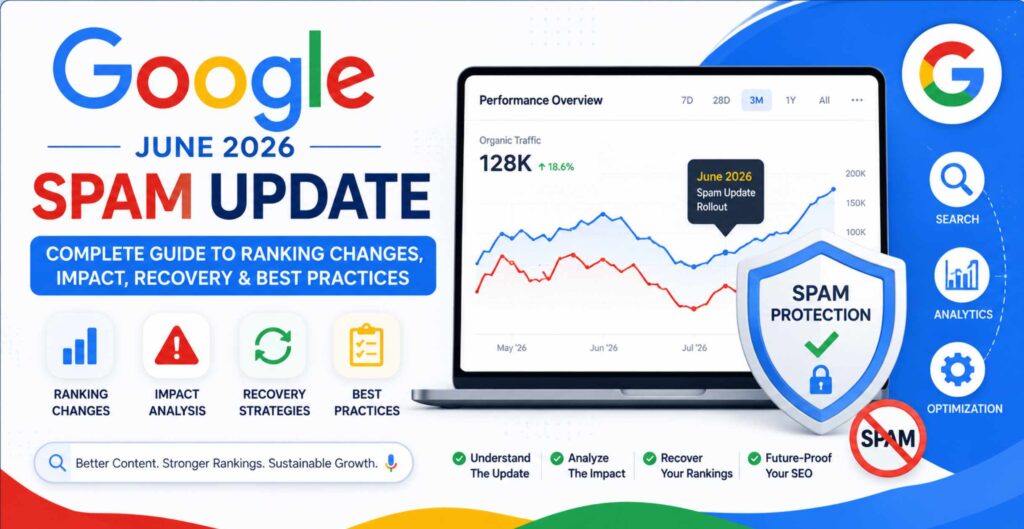
What is the Google June 2026 Spam Update?
The Google June 2026 Spam Update is Google’s latest spam-focused algorithm improvement designed to identify websites using manipulative SEO practices while rewarding websites that provide helpful, trustworthy, and original content.
Unlike core updates that broadly reassess content quality, a spam update specifically targets websites violating Google Search spam policies. These violations may include:
- AI-generated low-quality content
- Cloaking
- Hidden text
- Keyword stuffing
- Doorway pages
- Expired domain abuse
- Link spam
- Thin affiliate content
- Scaled content abuse
- Automatically generated pages with little user value
The objective of the Google June 2026 Spam Update is simple: improve search quality by ensuring users find reliable, helpful, and authentic content instead of spam.
This update continues Google’s long-term strategy of rewarding websites that prioritize user experience, expertise, originality, and transparency over shortcuts designed solely to manipulate rankings.
Why Does Google Release Spam Updates?
Google processes billions of searches every day. Without spam detection systems, low-quality websites could dominate search results.
Spam updates help:
- Improve search result quality
- Remove manipulative websites
- Reward helpful content
- Protect users from deceptive practices
- Encourage sustainable SEO
For businesses investing in long-term SEO, these updates are generally beneficial because they reduce unfair competition from spam-heavy websites.
Rollout Timeline and Official Announcements
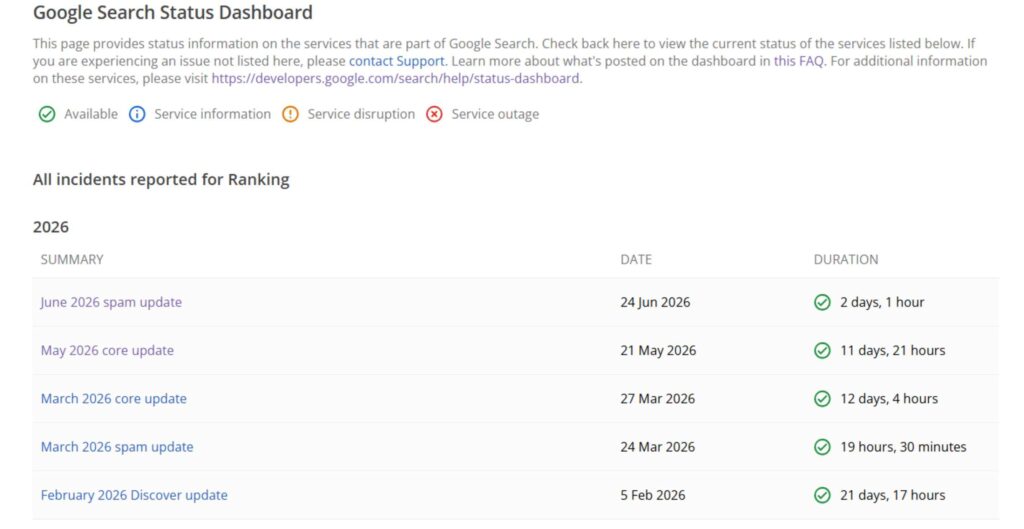
The June 2026 spam update began rolling out globally across Google Search and is expected to impact websites in multiple languages and industries.
Like previous spam updates, the rollout is gradual, meaning websites may experience ranking changes over several days before results stabilize.
During the rollout, many websites may notice:
- Sudden keyword ranking changes
- Organic traffic fluctuations
- Temporary indexing changes
- Reduced impressions
- Increased volatility in competitive niches
Google typically announces spam updates through its official Search Status Dashboard and Search Central communication channels. Website owners should rely on official announcements rather than rumors or unverified SEO discussions.
What Happens During the Rollout?
A spam update isn’t a manual penalty.
Instead, Google’s systems continuously reassess websites against its evolving spam detection models.
Some websites lose visibility because Google’s algorithms identify signals indicating spammy practices, while others gain rankings because competitors violating spam policies are removed from prominent search positions.
This explains why many sites experience both ranking losses and unexpected ranking improvements during a spam update rollout.
What Changed in the Google June 2026 Spam Update?
Although Google rarely discloses every technical detail behind its ranking systems, SEO observations suggest that the Google spam update June 2026 strengthened Google’s ability to detect manipulative optimization patterns.
The update appears to place greater emphasis on overall website quality rather than isolated pages.
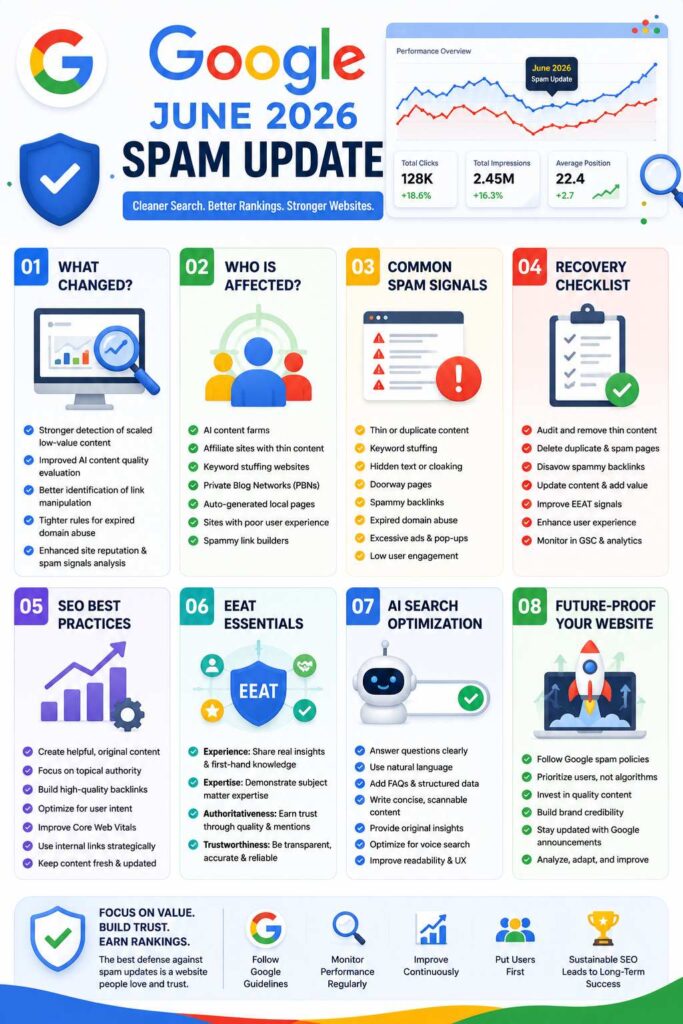
Potential areas receiving increased scrutiny include:
1. Scaled Low-Value Content
Websites publishing hundreds or thousands of pages with minimal original value are more likely to be affected.
Content created solely for rankings without satisfying user intent is increasingly vulnerable.
2. AI Content Without Human Value
Google does not penalize AI-generated content simply because AI was used.
However, content created at scale without fact-checking, original insights, or editorial review may perform poorly if it fails to deliver genuine value.
3. Link Manipulation
Google continues improving its detection of unnatural backlinks, paid links, excessive reciprocal linking, and private blog networks.
Rather than rewarding artificial authority, the search engine increasingly favors naturally earned mentions and editorial links.
4. Expired Domain Abuse
Purchasing expired domains solely to inherit authority and publish unrelated content remains a common spam tactic.
The latest update appears more effective at identifying these patterns.
5. Site Reputation Signals
Websites demonstrating clear expertise, transparent authorship, updated information, and trustworthy business details continue to perform better over time.
Strong EEAT signals remain an important component of long-term SEO success.
Which Websites Are Most Likely to Be Affected?
Not every ranking decline indicates a spam issue.
However, certain website types are generally more vulnerable during the Google June 2026 Spam Update.
Affiliate Sites with Thin Content
Affiliate websites offering little beyond product descriptions and affiliate links often struggle after spam updates.
Adding original reviews, comparisons, testing, and expert insights significantly improves quality.
AI Content Farms
Sites publishing massive amounts of AI-generated articles without editing or human expertise may experience substantial visibility losses.
Quality consistently outweighs quantity.
Websites Using Keyword Stuffing
Repeating the same keywords unnaturally throughout content no longer improves rankings.
Instead, it creates a poor user experience and may trigger spam signals.
Private Blog Network (PBN) Sites
Networks built primarily for manipulating backlinks remain a major target of Google’s spam detection systems.
Auto-Generated Local Pages
Creating thousands of city-specific pages with nearly identical content offers little value and may be considered scaled spam.
Hidden Redirects and Cloaking
Presenting different content to users and search engines continues to violate Google’s spam policies and can significantly reduce search visibility.
Poor User Experience Websites
Sites overloaded with intrusive ads, misleading navigation, deceptive popups, or excessive monetization may also see reduced visibility if user trust suffers.
Key Takeaways So Far
- The Google June 2026 Spam Update focuses on improving search quality.
- Websites relying on manipulative SEO techniques are at greater risk.
- Helpful, original, user-first content remains the safest long-term SEO strategy.
- Strong EEAT signals, transparent authorship, and high-quality content continue to be rewarded.
- Recovery is possible, but it requires addressing underlying quality and spam issues rather than chasing quick fixes.
Signs Your Website Was Impacted by the Google June 2026 Spam Update
If your website experienced unusual ranking movements during the Google June 2026 Spam Update, don’t panic. A temporary fluctuation doesn’t always indicate a penalty. The first step is to determine whether your site was genuinely affected by the update.
Here are the most common signs:
1. Sudden Organic Traffic Drop
A noticeable decline in organic traffic from Google Search is often the first indication of an algorithm update impact. Compare your traffic in Google Analytics and Google Search Console before and after the rollout.
Look for:
- A sharp decrease in clicks
- Lower impressions
- Reduced conversions from organic search
2. Keyword Ranking Decline
One of the clearest signs of the Google spam update June 2026 is a significant drop in keyword rankings. Keywords that consistently ranked on the first page may move to page two or beyond.
Monitor:
- High-value commercial keywords
- Informational blog keywords
- Brand and non-brand keyword performance
3. Indexing Changes
Some pages may no longer appear in Google Search or may lose their indexed status. Check Google Search Console for:
- Crawled but not indexed pages
- Soft 404 errors
- Indexing warnings
4. Loss of Featured Snippets
If your website previously earned featured snippets or People Also Ask positions, you may notice a decline in visibility after the spam update rollout.
5. Reduced Crawl Activity
Googlebot may crawl your website less frequently if it detects low-value or repetitive content.
How to Recover from the Google June 2026 Spam Update
If your website was affected, remember that recovery is possible. The key is to improve your website rather than look for shortcuts.
Step 1: Perform a Complete Content Audit
Review every important page on your website.
Ask:
- Does this page satisfy search intent?
- Is the information accurate and up to date?
- Does it offer original value?
- Would users bookmark or share this page?
Remove or improve:
- Thin pages
- Duplicate content
- Outdated articles
- AI-generated content without human editing
Step 2: Improve EEAT Signals
Google increasingly rewards websites demonstrating Experience, Expertise, Authoritativeness, and Trustworthiness.
Strengthen EEAT by:
- Adding detailed author bios
- Displaying business information
- Including references to authoritative sources
- Updating old content regularly
- Publishing first-hand experience where possible
Step 3: Remove Spam Signals
Check your website for:
- Hidden text
- Keyword stuffing
- Cloaking
- Doorway pages
- Excessive ads
- Spammy internal links
Any practice designed to manipulate rankings should be eliminated.
Step 4: Audit Your Backlinks
A healthy backlink profile remains important.
Remove or disavow:
- Paid links
- Link farms
- PBN links
- Irrelevant backlinks
- Spam directories
Focus on earning editorial backlinks through valuable content.
Step 5: Improve User Experience
Google rewards websites that users enjoy visiting.
Improve:
- Core Web Vitals
- Mobile responsiveness
- Navigation
- Readability
- Internal linking
- Page speed
A better user experience often leads to stronger engagement signals.
Step 6: Refresh Existing Content
Instead of constantly publishing new articles, improve your existing content.
Update:
- Statistics
- Screenshots
- Examples
- FAQs
- Internal links
- Structured data
Fresh content often regains visibility faster than neglected pages.
Google Spam Update Recovery Checklist
Use this checklist if you’re working on Google spam update recovery.
✅ Remove thin pages
✅ Delete duplicate content
✅ Improve topical authority
✅ Remove spammy backlinks
✅ Review AI-generated articles
✅ Update outdated blog posts
✅ Improve internal linking
✅ Add author information
✅ Strengthen EEAT signals
✅ Optimize Core Web Vitals
✅ Improve mobile usability
✅ Use structured data
✅ Follow Google Search spam policies
SEO Best Practices to Prevent Future Penalties
The best recovery strategy is prevention.
Publish Helpful Content
Every article should solve a real problem.
Avoid writing content simply because a keyword has search volume.
Focus on Topical Authority
Instead of writing hundreds of unrelated articles, become an expert in your niche.
Create topic clusters connected through internal links.
Avoid Keyword Stuffing
Use keywords naturally.
Search engines understand context better than ever.
Write for readers first.
Build High-Quality Backlinks
Earn backlinks by creating:
- Original research
- Case studies
- Industry reports
- Useful tools
- Comprehensive guides
Maintain Content Freshness
Review important pages every few months.
Update outdated information before it becomes inaccurate.
Monitor Google Search Console
Regular monitoring helps identify issues before they affect rankings significantly.
Google Discover, GEO & AI Search Optimization
Search is changing rapidly.
Today’s content should be optimized not only for traditional rankings but also for AI-powered search experiences.
Answer User Questions Clearly
Use concise paragraphs.
Include direct answers near the beginning of each section.
Add FAQ Sections
Rich FAQs improve visibility across search engines and AI assistants.
Use Descriptive Headings
Well-structured H2 and H3 headings help search engines understand content hierarchy.
Improve Readability
Use:
- Short paragraphs
- Bullet lists
- Tables where appropriate
- Clear formatting
Add Original Insights
AI systems increasingly prefer unique expertise over generic summaries.
Share:
- Practical experience
- Real examples
- Expert opinions
- Actionable recommendations
Voice Search Optimization
Many users now ask conversational questions.
Examples include:
- What is the Google June 2026 Spam Update?
- How do I recover from the Google June 2026 Spam Update?
- Why did my rankings drop after Google’s spam update?
Include these natural-language questions throughout your content to improve voice search visibility.
FAQ – Google June 2026 Spam Update
What is the Google June 2026 Spam Update?
The Google June 2026 Spam Update is an algorithm update designed to reduce the visibility of websites using spammy SEO techniques while rewarding websites that provide original, helpful, and trustworthy content.
How long does the June 2026 spam update take to roll out?
Most spam updates roll out over several days, although ranking fluctuations may continue for a short period afterward while Google’s systems stabilize.
Why did my rankings drop after the Google June 2026 Spam Update?
A ranking decline may result from thin content, spammy backlinks, keyword stuffing, scaled low-quality pages, or other violations of Google’s spam policies.
Can AI-generated content be affected?
Yes. AI-generated content isn’t penalized simply because AI was used. However, content lacking originality, accuracy, or real user value may lose rankings.
How can I recover from the Google spam update?
Focus on improving content quality, removing spam signals, strengthening EEAT, enhancing user experience, auditing backlinks, and following Google’s Search spam policies.
Does Google issue a manual penalty during a spam update?
Not necessarily. Most spam updates are algorithmic rather than manual actions.
Should I delete low-quality pages?
If a page offers little value, improving or removing it can strengthen your overall website quality.
Will rankings recover automatically?
Recovery depends on addressing the underlying issues. Simply waiting without making improvements is unlikely to restore lost visibility.
How can I protect my website from future spam updates?
Publish original content, follow Google’s guidelines, avoid manipulative SEO tactics, build natural backlinks, and prioritize user experience.
Is the Google June 2026 Spam Update different from a Core Update?
Yes. Core updates broadly reassess search quality, while spam updates specifically target websites violating Google’s spam policies.
Final Takeaways – Google June 2026 Spam Update
The Google June 2026 Spam Update reinforces Google’s long-standing commitment to delivering trustworthy, relevant, and user-focused search results. Websites relying on manipulative SEO tactics may experience reduced visibility, while those investing in helpful content, strong user experience, and transparent practices are more likely to succeed.
Rather than chasing algorithm loopholes, focus on building a website that genuinely serves your audience. Regular content audits, improved EEAT signals, technical SEO maintenance, and adherence to Google’s spam policies will help your site remain resilient through future updates.
If your rankings were affected, view this update as an opportunity to strengthen your content strategy. Sustainable SEO is built on quality, consistency, and trust—not shortcuts.
Key Action Plan
- Audit your website for thin or duplicate content.
- Remove spammy SEO practices and unnatural backlinks.
- Refresh outdated pages with accurate, valuable information.
- Strengthen author expertise and trust signals.
- Improve Core Web Vitals and mobile usability.
- Build topical authority with comprehensive content clusters.
- Monitor Google Search Console regularly for indexing and performance changes.
About Digital Coolie
Digital Coolie is a digital marketing and SEO resource dedicated to helping businesses, marketers, and website owners stay ahead of Google’s evolving search algorithms. Our content is based on industry best practices, official Google documentation, and practical SEO experience, providing actionable strategies that support long-term organic growth.