
The world of SEO is changing faster than ever. With AI-powered search engines like Google SGE and conversational tools like ChatGPT reshaping how users find information, traditional SEO alone is no longer enough.
That’s where Hybrid Engine Optimization (HEO) comes in.
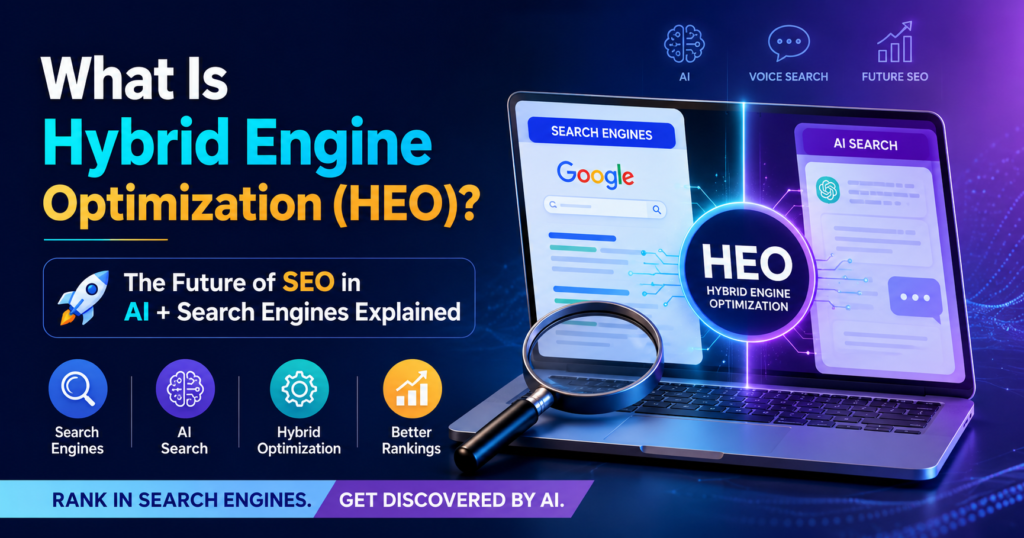
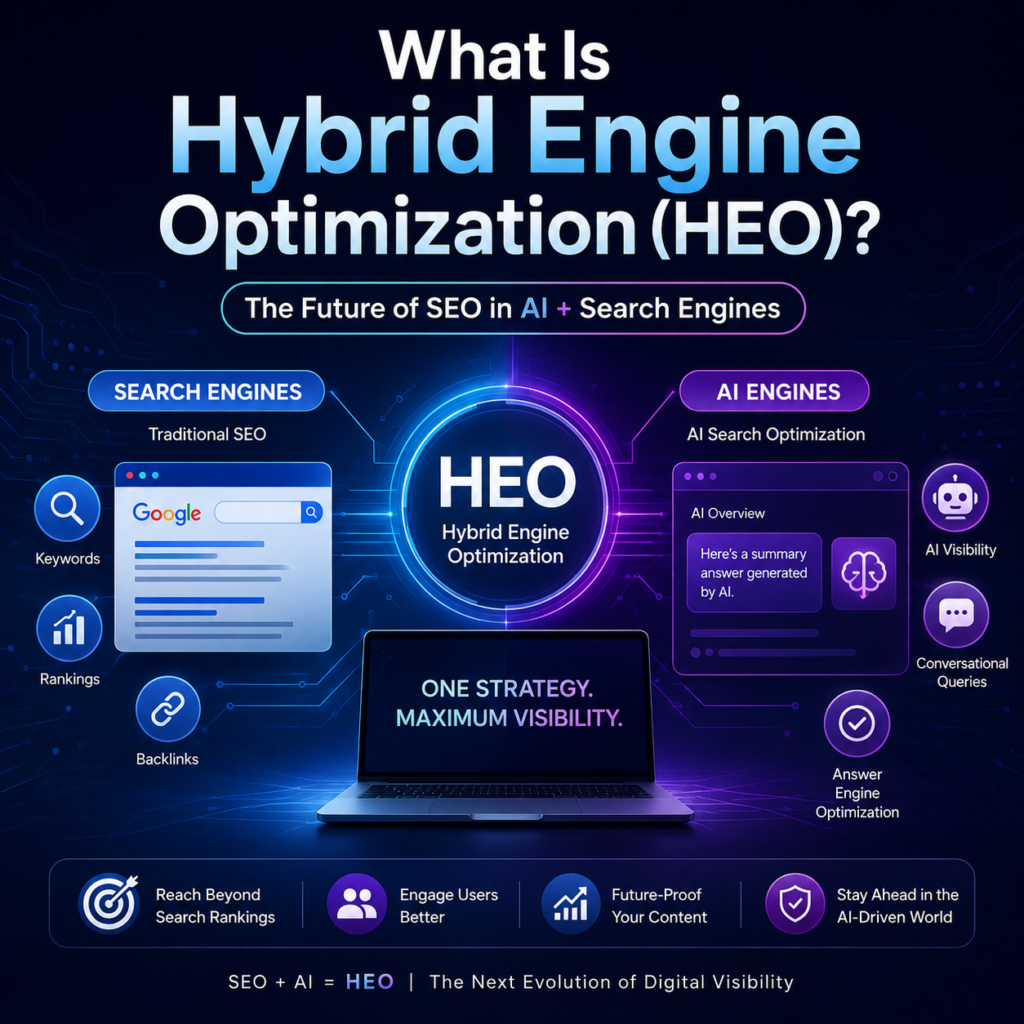
Hybrid Engine Optimization (HEO) is the next evolution of SEO that combines traditional search engine optimization with AI search optimization strategies to help your content rank across both search engines and AI-driven platforms.
If you want your website to stay visible in 2026 and beyond, understanding HEO in SEO is no longer optional — it’s essential.
What is Hybrid Engine Optimization (HEO)?
Hybrid Engine Optimization (HEO) is a modern SEO approach that optimizes content for both:
- Traditional search engines (Google, Bing)
- AI-powered search systems (ChatGPT, Google SGE, Perplexity AI)
Unlike traditional SEO, which focuses mainly on rankings in SERPs, HEO focuses on visibility across AI-generated answers, voice assistants, and conversational search experiences.
In Simple Terms:
HEO = SEO + AI Search Optimization + Answer Engine Optimization (AEO)
Why Hybrid Engine Optimization (HEO) Matters in 2026
Search behavior is evolving:
- Users now ask questions instead of typing keywords
- AI tools provide direct answers instead of links
- Zero-click searches are increasing
Key Shifts Driving HEO:
- Rise of AI-generated search results
- Voice search growth
- Conversational queries
- Personalized search experiences
If your content is not optimized for AI, you risk losing visibility – even if you rank #1 on Google.
HEO in SEO: How It’s Different from Traditional SEO
| Factor | Traditional SEO | Hybrid Engine Optimization (HEO) |
|---|---|---|
| Focus | Rankings on SERPs | Visibility across AI + Search |
| Keywords | Exact-match keywords | Intent + conversational queries |
| Content | Keyword-focused | Context + entity + intent-based |
| Results | Blue links | AI answers, snippets, voice responses |
| Strategy | Search engine algorithms | AI + Search + User intent |
AI Search Optimization: The Core of HEO
AI search optimization ensures your content is easily understood, extracted, and cited by AI systems.
How AI Understands Content:
- Natural language processing (NLP)
- Entity recognition
- Contextual meaning
- Structured data
What You Need to Do:
- Write clear, structured content
- Answer questions directly
- Use semantic keywords
- Build topical authority
Generative Engine Optimization vs HEO
Many marketers confuse Generative Engine Optimization (GEO) with HEO but they’re not the same.
Generative Engine Optimization (GEO)
- Focuses only on AI-generated platforms
- Optimizes content to appear in AI responses
Hybrid Engine Optimization (HEO)
- Covers both SEO + AI search
- Ensures visibility everywhere
Quick Comparison:
| Aspect | GEO | HEO |
|---|---|---|
| Scope | AI platforms only | AI + Search Engines |
| Strategy | AI-focused | Hybrid approach |
| Goal | AI visibility | Omnichannel visibility |
HEO is the future because it combines both worlds.
How to Rank in AI Search Results Using HEO
If you want to rank in AI search results, follow these proven strategies:
1. Focus on Search Intent (Not Just Keywords)
Understand what the user actually wants:
- Informational
- Transactional
- Navigational
2. Optimize for Conversational Queries
People now search like this:
- “What is Hybrid Engine Optimization?”
- “How to rank in AI search results?”
Use natural language in your content.
3. Structure Content for AI Readability
Use:
- Clear headings (H1, H2, H3)
- Bullet points
- Short paragraphs
4. Add FAQ Sections (Important for AEO)
FAQs help AI extract direct answers quickly.
5. Use Schema Markup
Structured data helps AI understand your content better.
6. Build Topical Authority
Create clusters around your main topic:
- AI SEO
- Voice search
- Future of SEO
7. Optimize for Featured Snippets
Use:
- Definitions
- Lists
- Tables
Future of SEO with AI: What to Expect
The future of SEO with AI is not about replacing SEO – it’s about evolving it.
Key Trends:
- AI-generated answers replacing search results
- Hyper-personalized search
- Voice-first search behavior
- Visual + multimodal search
What This Means:
Your content must be:
- Helpful
- Trustworthy
- Structured
- Easy to understand
SEO for AI Search Engines: Practical Checklist
Here’s a quick checklist to implement SEO for AI search engines:
✔ Use conversational keywords
✔ Answer questions clearly
✔ Add FAQs
✔ Use schema markup
✔ Optimize for mobile
✔ Improve page speed
✔ Build authority links
✔ Keep content updated
Best Practices for Hybrid Engine Optimization (HEO)
1. Write for Humans First, AI Second
If humans love your content, AI will too.
2. Use EEAT Principles
- Experience
- Expertise
- Authoritativeness
- Trustworthiness
3. Optimize for Voice Search
Voice queries are longer and more natural.
Example:
- Typed: “HEO SEO”
- Voice: “What is Hybrid Engine Optimization in SEO?”
4. Create High-Quality Long-Form Content
Google and AI prefer in-depth content.
5. Keep Content Updated
AI prefers fresh, accurate information.
Common Mistakes to Avoid in HEO
❌ Keyword stuffing
❌ Ignoring AI platforms
❌ Writing robotic content
❌ Not using structured data
❌ Skipping FAQs
Real-World Example of HEO
Let’s say someone searches:
“How to rank in AI search results?”
Traditional SEO Result:
- Blog post ranking on Google
HEO Result:
- Blog ranks on Google
- Appears in featured snippet
- Gets cited in AI tools
- Used in voice assistant answers
That’s the power of Hybrid Engine Optimization (HEO)
FAQs
What is Hybrid Engine Optimization (HEO)?
Hybrid Engine Optimization (HEO) is a strategy that combines traditional SEO and AI search optimization to improve visibility across search engines and AI platforms.
How is HEO different from SEO?
HEO goes beyond traditional SEO by optimizing content for AI-generated search results, voice search, and conversational queries.
What is HEO in SEO?
HEO in SEO refers to integrating AI optimization techniques with traditional SEO practices to rank in both search engines and AI systems.
What is AI search optimization?
AI search optimization focuses on making content understandable and usable by AI tools like ChatGPT and Google SGE.
Generative Engine Optimization vs HEO — which is better?
HEO is better for long-term growth because it covers both AI platforms and traditional search engines.
How to rank in AI search results?
To rank in AI search results:
- Use conversational content
- Answer questions clearly
- Structure your content properly
- Build authority
What is the future of SEO with AI?
The future of SEO with AI involves hybrid strategies where content is optimized for both humans and AI systems.
Why You Should Start Using HEO Today
The shift to AI-driven search is already happening.
If you rely only on traditional SEO, you risk losing visibility in the next wave of search evolution.
Hybrid Engine Optimization (HEO) is not just a trend it’s the future.
Businesses that adapt early will dominate both search engines and AI platforms.