
Introduction – How AI Features Work in Search
Search is no longer just about matching keywords to web pages. Today, Google’s search engine uses advanced artificial intelligence to understand context, user intent, relationships between topics, and even follow-up questions. This evolution has transformed how people discover information online and introduced a more intelligent, conversational search experience.
Understanding How AI Features Work in Search is essential for website owners, marketers, SEO professionals, and businesses looking to stay visible in modern search results. From Google AI Overviews to AI-powered search results, Google’s AI systems are reshaping the way information is presented and consumed.
In this guide, you’ll learn how Google’s AI search features work, how AI-generated answers are created, how websites can improve visibility in AI search experiences, and the SEO, GEO, and AEO strategies that matter most moving forward.
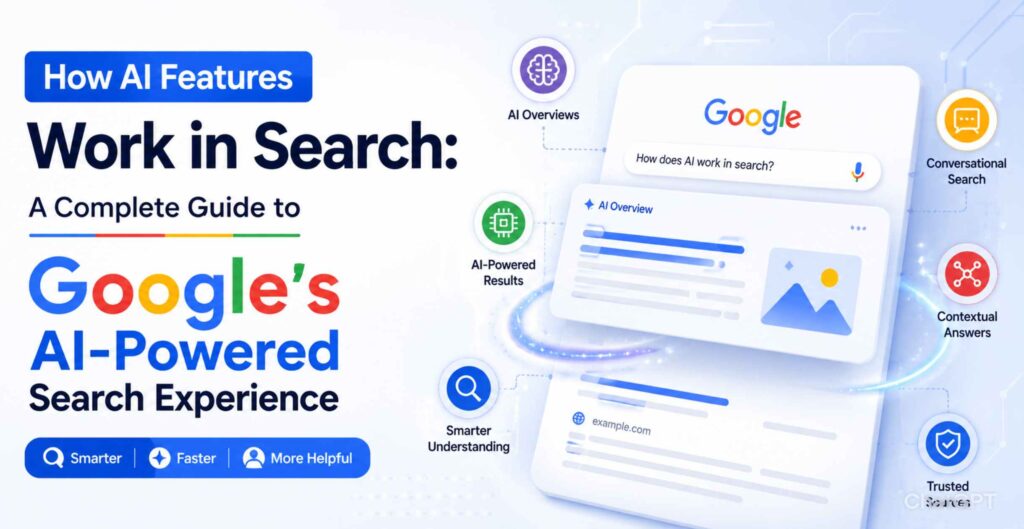
What Are AI Features in Google Search?
Google AI Search Features are intelligent systems designed to help users find accurate information faster. Instead of relying solely on keyword matching, Google uses artificial intelligence to understand meaning, context, and intent behind every search query.
These AI-powered capabilities include: – How AI Features Work in Search
- Google AI Overviews
- AI-generated summaries
- AI-enhanced search results
- Voice search responses
- Multimodal search
- Conversational search experiences
- Smart query understanding
The purpose of these features is to provide users with more relevant, helpful, and accurate answers while reducing the effort required to find information.
How AI Features Work in Search
Google’s AI-powered search experience combines machine learning, natural language processing (NLP), knowledge graphs, and ranking systems to deliver useful results.
Step 1: Understanding User Intent
The first step is identifying what the user truly wants.
For example, when someone searches:
“Best CRM software for small businesses”
Google understands that the searcher is likely looking for:
- Product recommendations
- Comparisons
- Pricing information
- Reviews
- Buying guidance
Instead of focusing only on keywords, Google’s AI evaluates the underlying intent behind the query.
Step 2: Analyzing Content Across the Web
Google’s AI systems continuously crawl and evaluate billions of pages.
The algorithms assess:
- Content relevance
- Expertise
- Trustworthiness
- User experience
- Authority signals
- Freshness of information
This process helps Google’s AI ranking systems identify the most reliable sources.
Step 3: Generating AI Search Results
After identifying useful information, AI systems organize and summarize content into helpful formats such as:
- AI Overviews
- Featured snippets
- Knowledge panels
- Related questions
- Product recommendations
This allows users to access answers more quickly.
Step 4: Delivering a Conversational Search Experience
Modern search is increasingly conversational.
Users can ask follow-up questions naturally, and Google’s AI understands the context of previous queries, making search feel more like interacting with an intelligent assistant than a traditional search engine.
How Does Google Use AI in Search?
Artificial intelligence powers multiple aspects of Google’s search ecosystem.
Query Understanding – How AI Features Work in Search
AI helps Google understand:
- Synonyms
- Search intent
- Misspellings
- Natural language queries
- Conversational questions
Content Analysis
Google evaluates content beyond keywords by analyzing:
- Topic relevance
- Context
- Entities
- Relationships between concepts
Ranking Improvements
Google’s AI ranking systems prioritize content that demonstrates:
- Expertise
- Experience
- Authority
- Trustworthiness
Spam Detection
AI also identifies low-quality content, manipulative SEO practices, and spam, helping maintain the quality of search results.
What Is Google AI Overviews?
Google AI Overviews are AI-generated summaries that appear at the top of selected search results.
Instead of forcing users to visit multiple websites, AI Overviews provide concise answers compiled from trusted sources across the web.
A typical AI Overview may include:
- Direct answers
- Key insights
- Step-by-step guidance
- Supporting links
This feature helps users understand a topic more quickly while still providing access to source websites.
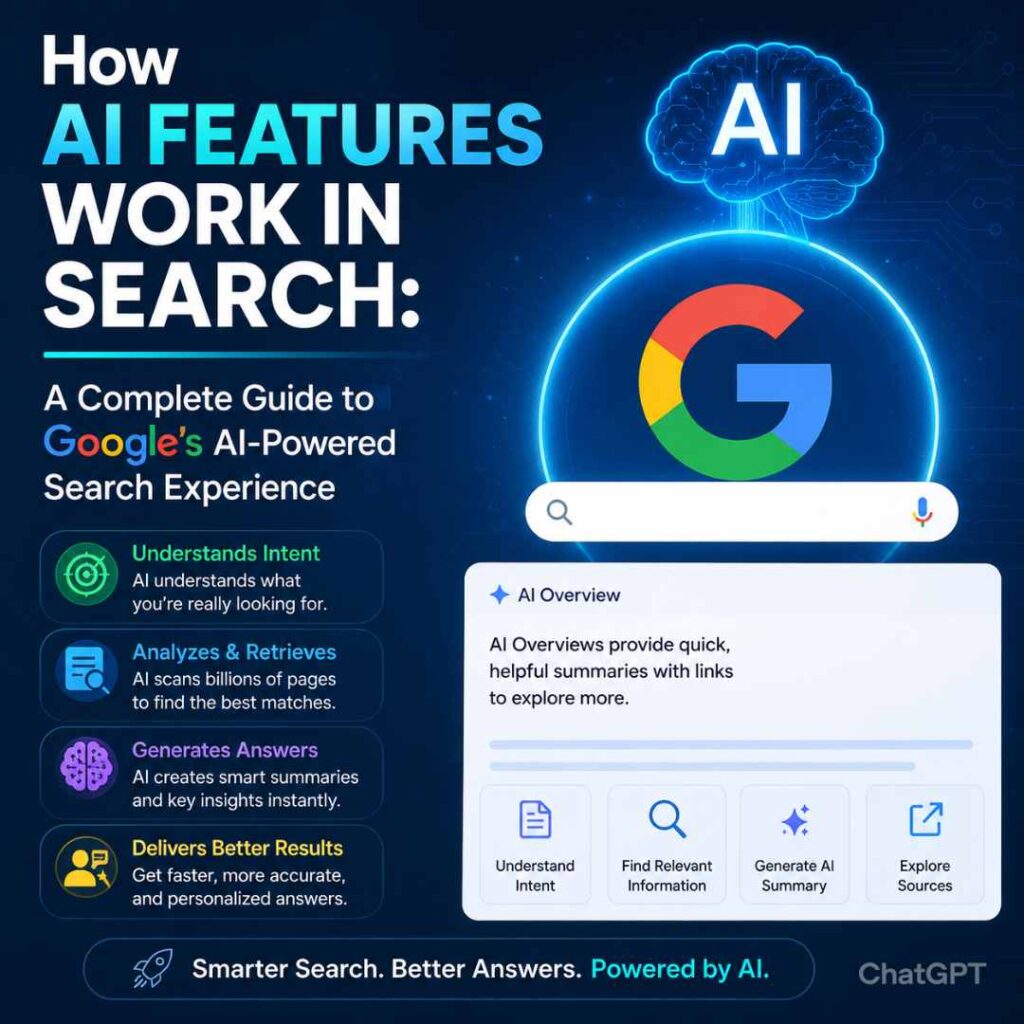
How Does Google Generate AI Overviews?
Google generates AI Overviews through a multi-step process:
Understanding Search Intent
The system first identifies what information the user needs.
Finding Relevant Sources
Google retrieves authoritative pages related to the query.
Synthesizing Information
Generative AI in Google Search combines information from multiple sources into a concise summary.
Displaying Helpful Responses
The AI-generated answer is presented alongside supporting links that users can explore for more detailed information.
How Do AI-Powered Search Results Work?
AI-powered search results combine:
- Traditional ranking systems
- Large language models
- Machine learning
- Knowledge Graph technology
These systems work together to:
- Understand user intent
- Retrieve relevant information
- Evaluate source quality
- Generate useful summaries
- Present the best answers
The result is a more accurate and efficient search experience.
How Does AI Improve Search Accuracy?
AI improves search quality by understanding meaning rather than simply matching keywords.
Benefits of AI in Search – How AI Features Work in Search
- Better understanding of context
- Improved relevance
- Faster answers
- Enhanced personalization
- Better voice search support
- Improved handling of complex questions
This helps users find exactly what they are looking for with fewer searches.
SEO Best Practices for Appearing in Google’s AI Search Features
Many website owners assume AI search requires a completely different optimization strategy. In reality, Google’s guidance is clear: the same SEO fundamentals that help websites rank in traditional search also help them appear in AI-powered search experiences.
Technical Requirements for AI Features
To appear as a supporting source in AI Overviews or AI Mode, your page must:
- Be indexed by Google
- Meet Google’s Search technical requirements
- Be eligible to appear in standard search results
- Allow Google to generate search snippets
There are currently no additional technical requirements specifically for AI Overviews.
Essential SEO Best Practices – How AI Features Work in Search
Allow Crawling and Indexing
- Verify robots.txt settings
- Remove unnecessary crawl restrictions
- Check CDN and hosting configurations
Strengthen Internal Linking
- Connect related content
- Build topic clusters
- Use descriptive anchor text
Prioritize User Experience
- Improve page speed
- Ensure mobile friendliness
- Simplify navigation
- Use HTTPS
Keep Important Information in Text
AI systems understand text better than images alone.
Support Content with Visual Assets
Include:
- Images
- Infographics
- Videos
- Screenshots
Implement Structured Data
Helpful schema types include:
- Article Schema
- FAQ Schema
- Organization Schema
- Breadcrumb Schema
Maintain Accurate Business Information
Keep your:
- Google Business Profile
- Merchant Center listings
- Contact details
fully updated.
How AI Systems Understand User Intent
Google’s AI classifies searches into intent categories.
Informational Intent – How AI Features Work in Search
Users seeking knowledge.
Example:
“What is AI Search?”
Navigational Intent
Users looking for a specific website.
Commercial Intent
Users comparing products and services.
Transactional Intent
Users ready to purchase or take action.
Content aligned with search intent is more likely to appear in AI-generated answers.
What Content Is Most Likely to Appear in AI-Generated Answers?
Content that performs well in AI Overviews typically includes:
- Direct answers
- Expert insights
- Original research
- Reliable sources
- Clear formatting
- FAQ sections
- Structured content
The easier it is for AI systems to understand your content, the greater the chance of being referenced.
EEAT and AI Search – How AI Features Work in Search
Google continues to emphasize:
Experience
Demonstrating first-hand knowledge.
Expertise
Showing subject matter competence.
Authoritativeness
Building industry recognition.
Trustworthiness
Providing accurate and reliable information.
Strong EEAT signals significantly improve your chances of visibility in AI-powered search experiences.
Structured Data and AI Visibility
Structured data helps search engines better understand page content.
Recommended schema types include:
- FAQ Schema
- Article Schema
- Organization Schema
- Breadcrumb Schema
While schema does not guarantee AI Overview inclusion, it improves content comprehension.
Optimizing Content for Answer Engines and AI Assistants
Answer Engine Optimization (AEO) focuses on helping AI systems retrieve and display your content.
AEO Best Practices
- Answer questions directly
- Use conversational language
- Create FAQ sections
- Optimize for voice search
- Build topical authority
- Use clear heading structures
Generative Engine Optimization (GEO): The Future of Search
Generative Engine Optimization helps websites gain visibility within AI-generated search experiences.
GEO Best Practices
- Create comprehensive content
- Build authority around topics
- Optimize entities
- Include supporting evidence
- Update content regularly
- Focus on EEAT
Measuring Performance in AI Search
You can monitor AI-related search performance using:
Google Search Console
Track:
- Clicks
- Impressions
- CTR
- Rankings
Google Analytics
Analyze:
- Engagement time
- Conversions
- User behavior
- Lead quality
AI search traffic often brings highly engaged visitors because users already have strong intent before clicking.
Conclusion – How AI Features Work in Search
Understanding How AI Features Work in Search is essential as Google’s search ecosystem becomes increasingly AI-driven. Features like Google AI Overviews, AI-powered search results, and conversational search experiences are transforming how users discover information online.
The good news is that success in AI search still depends on the same principles that have always mattered: creating helpful, trustworthy, people-first content. By focusing on SEO fundamentals, EEAT, structured data, AEO, and GEO strategies, businesses can improve visibility across both traditional and AI-powered search experiences.
The future of search belongs to websites that prioritize user value, expertise, and content quality.