
Google Launching Search Generative AI Performance Reports in Search Console
The future of search is becoming increasingly AI-driven, and Google is taking another major step toward helping website owners understand how their content performs in AI-powered search experiences.
With the introduction of Search Generative AI Performance Reports in Google Search Console, SEO professionals finally gain greater visibility into how websites appear and perform within Google’s AI-generated search experiences. As AI Overviews and generative search results continue reshaping user behavior, understanding AI search traffic has become essential rather than optional.
For years, website owners relied on traditional Search Console performance reports to track clicks, impressions, CTR, and rankings. However, the rise of generative AI search results created a visibility gap. Publishers often struggled to understand whether traffic originated from traditional search listings or AI-powered search experiences.
Google’s new reporting capabilities aim to close that gap.
In this guide, we’ll explore what Search Generative AI Performance Reports are, why Google is launching them, the metrics included, and how they can transform modern SEO strategies.
What Are Search Generative AI Performance Reports?
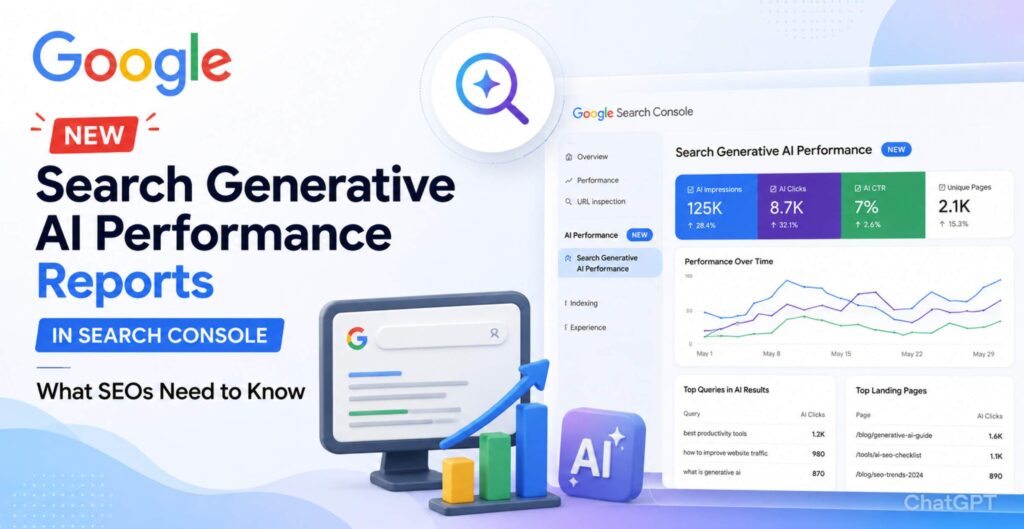
Search Generative AI Performance Reports are new reporting features within Google Search Console designed to help website owners measure performance in AI-powered search environments.
These reports provide deeper insights into how content performs when it appears within:
- AI Overviews
- Generative AI search results
- AI-enhanced search experiences
- Conversational search interfaces
- Future Google AI search features
The goal is to give publishers a clearer understanding of their visibility beyond traditional blue-link rankings.
Instead of relying solely on conventional search performance metrics, website owners can now access more comprehensive AI search traffic analytics and understand how users interact with AI-generated search experiences.
Key Benefits – Search Generative AI Performance Reports
- Better visibility into AI search appearances
- Improved traffic attribution
- Enhanced content performance measurement
- More accurate AI search optimization strategies
- Stronger understanding of evolving search behavior
Why Is Google Adding AI Search Reporting to Search Console?
Google’s search ecosystem is changing rapidly.
As AI Overviews become a standard component of search results, users increasingly receive summarized answers directly within search pages. This changes how people discover websites, consume content, and click through to external pages.
Without dedicated reporting, publishers face several challenges:
- Limited understanding of AI-generated visibility
- Difficulty measuring AI-driven traffic
- Incomplete SEO performance data
- Challenges proving ROI from content investments
The introduction of Google Search Console AI reports addresses these concerns by creating transparency between traditional search and AI-enhanced search experiences.
Google’s Goals
Google aims to:
- Improve reporting transparency
- Help publishers adapt to AI-powered search
- Provide actionable AI-powered search insights
- Support data-driven content optimization
- Encourage higher-quality content creation
This aligns with Google’s ongoing focus on helpful, people-first content and improved search ecosystem accountability.
How Can Website Owners Track AI Search Traffic?
Tracking AI search traffic has become one of the most important challenges for modern SEO teams.
The new Search Generative Experience reporting capabilities are expected to provide clearer attribution for traffic generated through AI search features.
Website owners can use these reports to monitor:
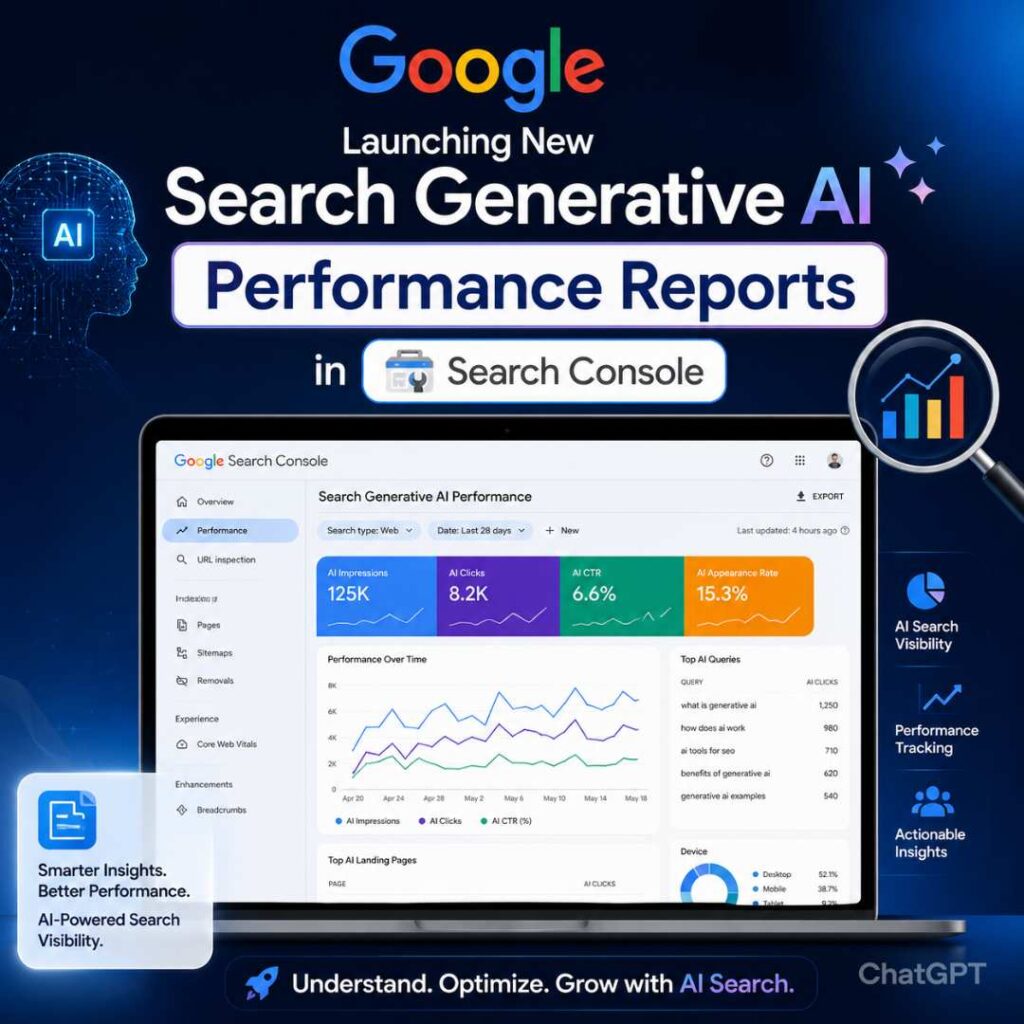
AI Impressions
How often content appears within AI-generated search experiences.
AI Clicks
The number of users who visit a website after interacting with AI search features.
AI CTR (Click-Through Rate)
The percentage of users who click after seeing content referenced in AI-generated responses.
Query Performance
Which search queries trigger AI-related visibility.
Landing Page Performance
Which pages generate the strongest results from AI-powered search environments.
Together, these metrics create a more comprehensive picture of Google AI search performance.
What Metrics Are Included in the New AI Performance Reports?
Although Google’s AI reporting framework may continue evolving, several key metrics are expected to become central to the new reporting experience.
1. AI Impressions
Measures how frequently content is surfaced within AI-generated search responses.
This metric helps determine overall AI visibility and discoverability.
2. AI Clicks
Tracks user interactions resulting in website visits from AI-enhanced search experiences.
This remains one of the most important indicators of business value.
3. AI CTR
Shows the percentage of impressions that generate clicks.
A higher CTR may indicate:
- Strong content relevance
- Effective authority signals
- Better user trust
- Enhanced answer quality
4. AI Query Data
Provides insights into which searches trigger AI visibility.
This information supports content expansion opportunities and keyword discovery.
5. Landing Page Insights
Identifies pages that perform well within generative AI environments.
This helps marketers prioritize content updates and optimization efforts.
6. Search Performance Metrics by AI Feature
Potential segmentation may include:
- AI Overviews
- Generative answers
- Conversational search results
- Future AI search experiences
This level of reporting enables more advanced AI-driven search optimization strategies.
How Do AI Search Reports Impact SEO Strategy?
The arrival of Search Generative AI Performance Reports marks a significant shift in SEO measurement.
Traditional SEO focused heavily on rankings.
Modern SEO focuses on visibility.
In AI-powered search environments, ranking position alone no longer tells the entire story.
New SEO Priorities
Content Authority
AI systems favor content that demonstrates expertise, experience, authority, and trustworthiness.
Topical Depth
Comprehensive content is more likely to be referenced in AI-generated answers.
Structured Data
Schema markup helps AI systems understand content more effectively.
Entity Optimization
Search engines increasingly rely on entity relationships rather than exact keywords.
User Intent Coverage
Content must answer complete user journeys rather than isolated questions.
These changes reinforce Google’s EEAT principles and encourage the creation of genuinely helpful content.
What Is the Difference Between Traditional Search Reports and AI Search Reports?
Many marketers wonder whether AI reports simply duplicate existing Search Console performance reports.
The answer is no.
Traditional Search Reports
Traditional reports focus on:
- Organic impressions
- Organic clicks
- CTR
- Average position
- Search queries
- Device data
These metrics measure conventional search results performance.
AI Search Reports
AI reports focus on:
- AI-generated appearances
- AI Overview visibility
- AI click interactions
- Generative search exposure
- AI user engagement
- AI-driven traffic sources
Key Difference – Search Generative AI Performance Reports
Traditional reporting measures ranking performance.
AI reporting measures answer visibility.
As AI search evolves, understanding both perspectives becomes critical.
How Search Generative Experience Reporting Supports Google AI Overview Tracking
AI Overviews are becoming one of the most influential elements in Google’s search ecosystem.
For publishers, understanding when content contributes to AI Overviews can reveal:
- New traffic opportunities
- Content authority signals
- Emerging search trends
- Competitive positioning
With enhanced Google AI Overview tracking, marketers can identify which pages consistently appear within AI-generated summaries and optimize accordingly.
Optimization Opportunities
- Strengthen factual accuracy
- Add expert insights
- Improve content freshness
- Expand topic coverage
- Enhance structured data
These improvements increase the likelihood of future AI visibility.
Best Practices for Improving Google AI Search Performance
Organizations that adapt early may gain a significant competitive advantage.
Create Helpful Content
Focus on solving real user problems.
Avoid keyword stuffing and prioritize value.
Demonstrate Experience
Include:
- First-hand expertise
- Case studies
- Original research
- Industry insights
Build Topical Authority
Create interconnected content clusters around core topics.
Improve Content Structure
Use:
- Clear headings
- FAQ sections
- Bullet points
- Tables
- Definitions
This improves readability for both users and AI systems.
Optimize for Conversational Queries
AI search frequently processes natural language questions.
Target:
- Long-tail keywords
- Voice search queries
- Question-based searches
Maintain Content Freshness
Update content regularly to remain relevant and trustworthy.
Why AI Search Traffic Analytics Matter More Than Ever
The search landscape is shifting from ranking-based discovery to answer-based discovery.
This transformation creates new challenges:
- Reduced visibility into user journeys
- Increased competition for AI citations
- More complex attribution models
By leveraging AI search traffic analytics, businesses can better understand:
- Where traffic originates
- Which content drives AI visibility
- Which topics perform best
- How AI influences user behavior
These insights support smarter content investment decisions.
EEAT and Search Generative AI Performance Reports
Google’s EEAT framework remains crucial in AI search environments.
Experience
Show real-world expertise and practical knowledge.
Expertise
Publish content written or reviewed by knowledgeable professionals.
Authoritativeness
Build credibility through high-quality content and trusted references.
Trustworthiness
Ensure factual accuracy, transparency, and reliability.
Websites demonstrating strong EEAT signals are more likely to gain visibility in generative AI search results.
The Future of Search Console Performance Reports
The addition of AI-focused reporting represents a major evolution for Google Search Console.
Future enhancements may include:
- More granular AI reporting
- AI citation tracking
- Query intent categorization
- Enhanced search analytics dashboard features
- Advanced AI attribution models
As AI-powered search becomes mainstream, these insights will become essential for measuring success.
Businesses that understand and leverage these reports early will be better positioned to maintain strong organic search visibility in the years ahead.
Key Takeaways – Search Generative AI Performance Reports
Google’s new Search Generative AI Performance Reports signal a major shift in how website performance is measured.
The introduction of dedicated AI reporting helps publishers:
- Track AI search visibility
- Understand AI-generated traffic
- Improve content performance
- Strengthen SEO strategies
- Adapt to evolving search behavior
As AI-powered search continues expanding, marketers who embrace these insights will be better equipped to succeed in the next generation of search.
FAQs – Search Generative AI Performance Reports
What are Search Generative AI Performance Reports?
Search Generative AI Performance Reports are new Google Search Console reporting features that help website owners measure visibility, impressions, clicks, and engagement within AI-generated search experiences.
Why is Google adding AI search reporting to Search Console?
Google is introducing AI reporting to improve transparency and help publishers understand how their content performs in generative AI search results and AI Overviews.
How can website owners track AI search traffic?
Website owners can use Google Search Console AI reports to monitor AI impressions, AI clicks, click-through rates, queries, and landing page performance associated with AI search experiences.
What metrics are included in the new AI performance reports?
Key metrics include impressions, clicks, CTR, AI search visibility, query performance, landing page performance, and other AI-powered search insights.
How do AI search reports impact SEO strategy?
AI search reports help marketers understand visibility within AI-generated answers, improve content optimization efforts, strengthen EEAT signals, and refine AI-driven search optimization strategies.
What is the difference between traditional search reports and AI search reports?
Traditional Search Console performance reports focus on rankings and organic traffic, while AI search reports focus on visibility and engagement within generative AI search results and AI Overviews.
How does Google AI Overview tracking help publishers?
Google AI Overview tracking helps publishers identify which content appears in AI-generated summaries and optimize pages to improve future AI visibility and traffic.
Conclusion – Search Generative AI Performance Reports
The launch of Search Generative AI Performance Reports is one of the most important Search Console updates for SEO professionals in recent years. As AI reshapes how users interact with search engines, visibility within generative search experiences is becoming just as important as traditional rankings.
Organizations that leverage Google Search Console AI reports, monitor AI search traffic analytics, and continuously optimize content for EEAT, Answer Engine Optimization (AEO), and Generative Engine Optimization (GEO) will be best positioned to thrive in the evolving search landscape.