
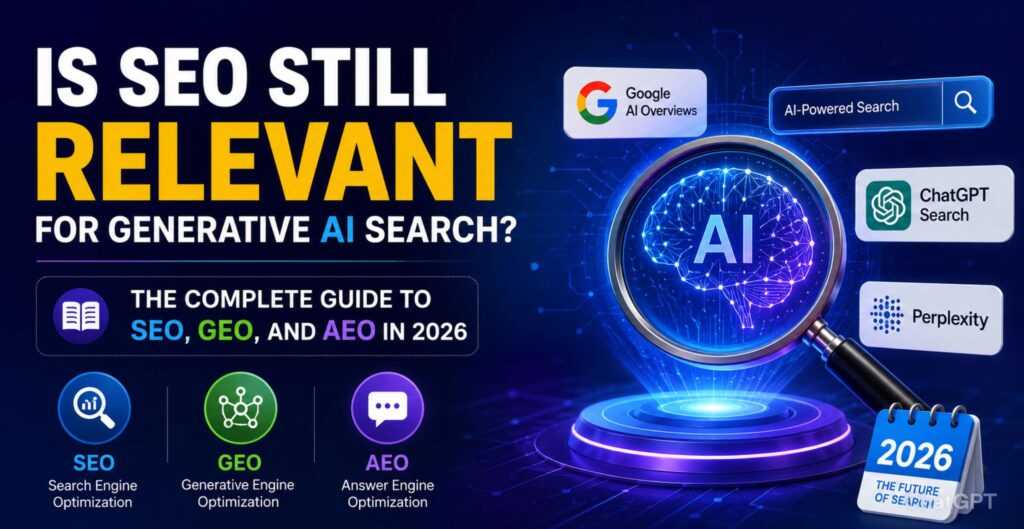
SEO for Generative AI Search has become one of the most discussed topics in digital marketing. With the rise of Google AI Overviews, ChatGPT Search, Perplexity, Gemini, and other AI-powered search engines, many marketers are asking the same question:
Is traditional SEO dead?
The short answer is no. – SEO for Generative AI Search
SEO is not disappearing. Instead, it is evolving into something broader that includes Generative AI Search Optimization, Answer Engine Optimization (AEO), and Generative Engine Optimization (GEO).
As AI-generated search results become more common, websites must optimize not only for search rankings but also for AI citations, answer visibility, entity recognition, and topical authority.
In this guide, you’ll learn how SEO, GEO, and AEO work together, how AI search engines select sources, and what strategies will help your content rank in AI search results throughout 2026 and beyond.
What Is Generative AI Search? – SEO for Generative AI Search
Generative AI Search refers to search experiences where artificial intelligence generates direct answers by combining information from multiple sources instead of simply displaying a list of blue links.
Examples include:
- Google AI Overviews
- ChatGPT Search
- Perplexity AI
- Gemini Search Experiences
- Microsoft Copilot Search
Instead of asking users to click through multiple websites, these platforms provide summarized responses generated by AI.
How Generative AI Search Works
AI systems typically:
- Analyze the search query.
- Retrieve relevant content from trusted sources.
- Evaluate authority and relevance.
- Generate a summarized answer.
- Cite selected sources when appropriate.
This shift has created a new challenge:
How do websites become the source AI chooses?
The answer begins with strong SEO fundamentals.
Has Traditional SEO Become Obsolete?
Many experts predicted the death of SEO every time search evolved.
People said SEO would die when:
- Mobile search became dominant.
- Voice search gained popularity.
- Social media grew.
- Google introduced featured snippets.
- AI entered search.
Yet SEO continued to adapt.
Why Traditional SEO Still Exists
Search engines and AI systems still need:
- High-quality content
- Reliable sources
- Structured information
- Trustworthy websites
- Strong authority signals
Without optimized content, AI systems would have no trustworthy information to summarize.
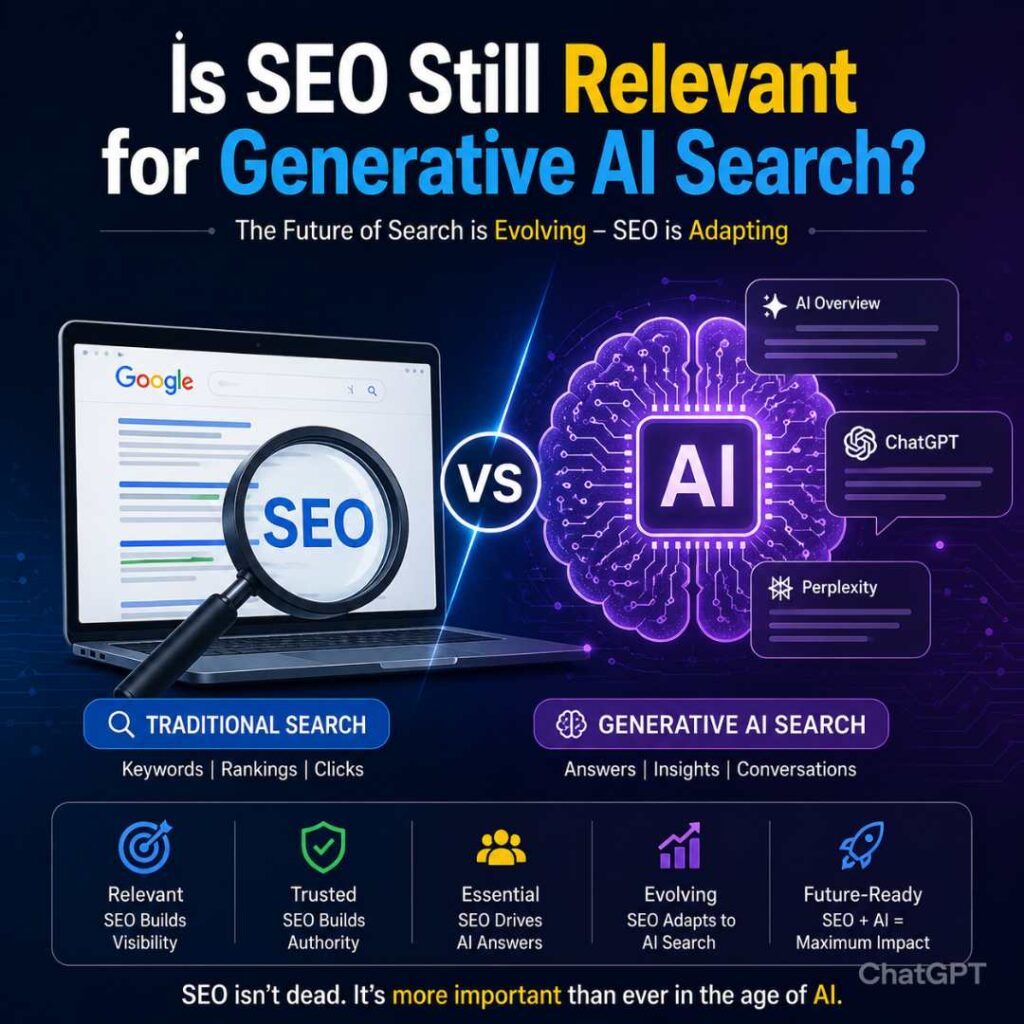
Think of AI as a new layer on top of search rather than a replacement for search.
Why SEO Still Matters for AI Search Engines
SEO for Generative AI Search Starts with Traditional SEO
Generative AI systems rely heavily on content that is already visible, authoritative, and well-structured.
Core SEO signals remain critical:
Content Quality
AI models favor:
- Original insights
- Expert-backed content
- Accurate information
- Comprehensive coverage
Website Authority
Strong authority increases the likelihood of:
- AI citations
- Featured mentions
- Inclusion in AI-generated search results
Technical SEO
Important factors include:
- Crawlability
- Indexability
- Fast page speed
- Mobile responsiveness
- Structured data
E-E-A-T Signals
Google continues emphasizing:
- Experience
- Expertise
- Authoritativeness
- Trustworthiness
These signals help AI systems determine whether your content deserves visibility.
What Is GEO (Generative Engine Optimization)?
Generative AI Search Optimization Explained
Generative Engine Optimization (GEO) is the process of optimizing content specifically for AI-generated answers.
Traditional SEO focuses on ranking pages.
GEO focuses on becoming a source used by AI systems.
GEO Goals
A successful GEO strategy helps your content:
- Get cited in AI responses
- Become part of generated summaries
- Increase brand mentions
- Improve entity recognition
- Build topical authority
GEO Best Practices
Create Comprehensive Content
AI prefers complete resources that answer multiple related questions.
Use Clear Context
Explain concepts thoroughly.
Avoid vague statements.
Build Topical Authority
Publish content clusters around a specific subject.
Use Entity-Based SEO
Modern AI systems understand entities rather than simple keywords.
Examples of entities include:
- Brands
- Products
- People
- Organizations
- Concepts
The stronger your entity signals, the easier it becomes for AI systems to understand your expertise.
What Is AEO (Answer Engine Optimization)?
Understanding Answer Engine Optimization (AEO)
Answer Engine Optimization focuses on creating content that directly answers user questions.
This strategy is especially important for:
- Voice search
- Featured snippets
- AI assistants
- Chatbots
- AI-generated answers
Why AEO Matters
Modern users increasingly ask:
- What is SEO for Generative AI Search?
- How does GEO work?
- Why is AEO important?
AI systems look for content that provides concise and accurate answers.
AEO Best Practices
Use Question-Based Headings
Example:
- What is GEO?
- Why is SEO important for AI search?
Answer Immediately
Provide the answer within the first paragraph.
Create FAQ Sections
FAQ content improves answer extraction opportunities.
Use Structured Data
Schema markup helps machines understand content.
SEO vs GEO vs AEO Comparison – SEO for Generative AI Search
| Factor | SEO | GEO | AEO |
|---|---|---|---|
| Primary Goal | Rank webpages | Become AI source | Answer user questions |
| Focus | Search engines | AI engines | Answer engines |
| Optimization Target | SERPs | AI summaries | Direct answers |
| Success Metric | Rankings | Citations | Featured answers |
| Content Style | Keyword-focused | Context-focused | Question-focused |
| Importance in 2026 | High | Very High | Very High |
The Reality
The future is not SEO versus GEO versus AEO.
The future is:
SEO + GEO + AEO working together.
How ChatGPT, Google AI Overviews & Perplexity Select Sources
Understanding source selection is critical for ranking in AI search results.
Google AI Overviews
Google often prioritizes:
- High-authority domains
- Reliable sources
- Structured content
- E-E-A-T signals
ChatGPT Search Optimization
ChatGPT search optimization involves improving:
- Content quality
- Clarity
- Authority
- Entity recognition
AI systems prefer information that is easy to understand and verify.
Perplexity AI
Perplexity emphasizes:
- Source credibility
- Factual accuracy
- Fresh content
- Comprehensive coverage
Common Factors Across AI Systems
Most AI-powered search engines evaluate:
- Authority
- Trust
- Expertise
- Relevance
- Structured information
- Entity relationships
- User satisfaction
Best Practices to Rank in AI Search Results
1. Focus on Topical Authority
Cover an entire topic instead of a single keyword.
Example:
If writing about SEO for Generative AI Search, also cover:
- GEO
- AEO
- AI Search Engine Optimization
- Google AI Overviews
- Entity SEO
2. Build Entity-Based SEO Signals
Search engines increasingly understand entities.
Strengthen entity recognition through:
- Consistent branding
- Author profiles
- About pages
- Knowledge graph references
- Structured data
3. Create Experience-Driven Content
AI systems increasingly value first-hand experience.
Include:
- Case studies
- Examples
- Data
- Real-world applications
4. Optimize for Question Queries
Users ask AI systems conversational questions.
Examples:
- Is SEO still relevant in AI search?
- How do AI search engines rank websites?
- What is GEO optimization?
Answer these naturally within your content.
5. Use Structured Content
Organize content using:
- H2 headings
- H3 headings
- Bullet lists
- Tables
- FAQs
This improves machine readability.
6. Publish Original Research
Original insights increase:
- Citations
- Backlinks
- Brand authority
AI systems often favor unique information over recycled content.
7. Improve Content Freshness
Regular updates help maintain relevance.
Update:
- Statistics
- Examples
- Industry trends
- Search behavior insights
8. Implement Schema Markup
Recommended schema types:
- FAQ Schema
- Article Schema
- Organization Schema
- Author Schema
- Breadcrumb Schema
Schema helps AI understand your content better.
9. Strengthen Brand Authority
AI increasingly recognizes brands as trust signals.
Build authority through:
- Thought leadership
- Digital PR
- Guest posting
- Expert contributions
10. Write for Humans First
The most effective AI Search Engine Optimization strategy remains:
Create content that genuinely helps people.
Helpful content consistently performs better across traditional and AI search systems.
Future of SEO in an AI-First Search World – SEO for Generative AI Search
The future of search will not eliminate SEO.
Instead, SEO will evolve into a broader framework combining:
Traditional SEO
Ensures visibility in search results.
GEO
Improves AI citation opportunities.
AEO
Optimizes content for direct answers.
Brand SEO
Builds authority and trust.
Entity SEO
Strengthens machine understanding.
Experience SEO
Highlights real-world expertise.
The websites that succeed in 2026 will be those that combine all of these approaches into a unified strategy.
Key Takeaways
✔ SEO remains highly relevant in 2026.
✔ Generative AI Search Optimization is becoming essential.
✔ GEO helps content become an AI-cited source.
✔ AEO helps content appear in direct answers.
✔ Google AI Overviews are changing search behavior.
✔ ChatGPT search optimization requires authority and clarity.
✔ Entity-based SEO is becoming increasingly important.
✔ E-E-A-T remains a critical ranking factor.
✔ AI search engines still rely on quality content.
✔ The future belongs to brands that integrate SEO, GEO, and AEO.
SEO for Generative AI Search – SEO Isn’t Dead – It’s Evolving
The debate around whether SEO is still relevant misses the bigger picture.
SEO has never been static.
From mobile-first indexing to voice search and now AI-powered search engines, SEO has continuously adapted to new technologies and user behaviors.
Today, success requires more than keyword optimization alone.
To thrive in the era of AI-generated search results, businesses must combine:
- SEO for visibility
- GEO for AI citations
- AEO for direct answers
- Entity-based SEO for understanding
- E-E-A-T for trust
The websites that embrace this evolution will be best positioned to dominate both traditional search results and AI search experiences.
The future isn’t SEO versus AI.
The future is SEO for Generative AI Search.
FAQs – SEO for Generative AI Search
Is SEO for Generative AI Search different from traditional SEO?
Yes. Traditional SEO focuses on ranking webpages, while SEO for Generative AI Search also focuses on becoming a trusted source cited by AI systems such as ChatGPT, Google AI Overviews, and Perplexity.
What is the difference between GEO vs SEO?
SEO focuses on search rankings, while GEO focuses on optimizing content so generative AI engines use it in AI-generated responses.
What is Answer Engine Optimization (AEO)?
Answer Engine Optimization (AEO) is the practice of creating content that directly answers user questions for voice search, AI assistants, featured snippets, and AI search platforms.
How can I improve Ranking in AI Search Results?
You can improve Ranking in AI Search Results by creating authoritative content, building topical authority, implementing structured data, strengthening E-E-A-T signals, and focusing on Generative AI Search Optimization.
Does ChatGPT use SEO signals?
Many signals associated with quality SEO such as authority, expertise, clarity, and content structure help increase the likelihood that content will be referenced in AI-generated responses.
Are Google AI Overviews replacing organic search?
No. Google AI Overviews are enhancing search experiences, but organic search listings remain important for visibility, traffic, and authority.