
Introduction – Generative AI Search Myths
Artificial intelligence is rapidly transforming how people discover information online. With the rise of AI-generated search results, Google’s AI Overviews, and conversational search experiences, a new wave of advice has flooded the SEO industry.
Unfortunately, not all of that advice is accurate.
Many website owners are investing time and resources into tactics they believe will improve visibility in AI-powered search engines. However, several of these strategies are based on misunderstandings rather than actual ranking signals.
In this guide, we’ll debunk the most common Generative AI Search Myths, explain how generative search works, and reveal what Google actually recommends for sustainable visibility in AI search experiences.
If you’re looking for practical insights into Generative AI search optimization, this article will help separate facts from fiction.
Why Generative AI Search Is Different from Traditional Search
Traditional search engines primarily provide a list of links that users can explore.
Generative AI search takes a different approach. Instead of only displaying links, AI systems generate summarized answers using information gathered from multiple sources across the web.
This evolution has led many marketers to assume that entirely new optimization methods are required.
The reality is more nuanced.
While AI-generated search results create new opportunities for visibility, the foundation remains largely the same:
- High-quality content
- Strong technical SEO
- Demonstrated expertise
- Trustworthy information
- Positive user experience
Understanding how generative search works is essential before implementing any optimization strategy.
Generative AI Search Myths #1: You Need to Create Separate Content for AI Search
One of the biggest Google AI search myths is the belief that websites need dedicated AI-specific pages.
Some marketers recommend creating duplicate content designed exclusively for AI crawlers.
Google has clearly indicated that this isn’t necessary.
AI systems are already capable of understanding:
- Context
- Synonyms
- User intent
- Topic relationships
Creating separate versions of content can actually create unnecessary complexity.
What You Should Do Instead
Focus on:
- Comprehensive topic coverage
- Clear structure
- Helpful answers
- Original insights
The same content that serves users effectively can also perform well in AI-powered search experiences.
Key Takeaway
You do not need separate content for AI search engines.
You need better content for people.
Generative AI Search Myths #2: Keyword Stuffing Helps AI Systems Understand Content Better
Keyword stuffing has been ineffective for years, yet it continues to resurface in discussions around Generative AI search optimization.
Some believe repeating keywords excessively helps AI understand relevance.
Modern AI systems don’t work that way.
They analyze:
- Meaning
- Context
- Relationships between concepts
- Entities
- User intent
Google’s AI systems understand natural language far beyond exact keyword matches.
Why Keyword Stuffing Hurts Performance
Over-optimized content often:
- Reduces readability
- Lowers user engagement
- Appears spammy
- Damages trust
Better Approach
Use:
- Natural language
- Semantic relevance
- Entity-based SEO
- Topic clusters
Instead of forcing keywords, focus on answering real questions users ask.
Generative AI Search Myths #3: AI Search Eliminates the Need for SEO
Perhaps the most dangerous of all Generative AI Search Myths is the belief that SEO is dead.
AI search does not replace SEO.
It builds upon it.
Google’s AI-generated experiences still rely heavily on content discovered through traditional search infrastructure.
SEO Still Matters Because
AI systems need:
- Crawlable websites
- Indexed pages
- Clear site architecture
- Reliable content signals
- Trust indicators
Without these fundamentals, visibility becomes significantly harder.
Modern SEO and AI Search
Today’s SEO strategy should include:
- Technical SEO
- Content quality
- EEAT principles
- Structured data
- User experience
AI search expands SEO rather than replacing it.
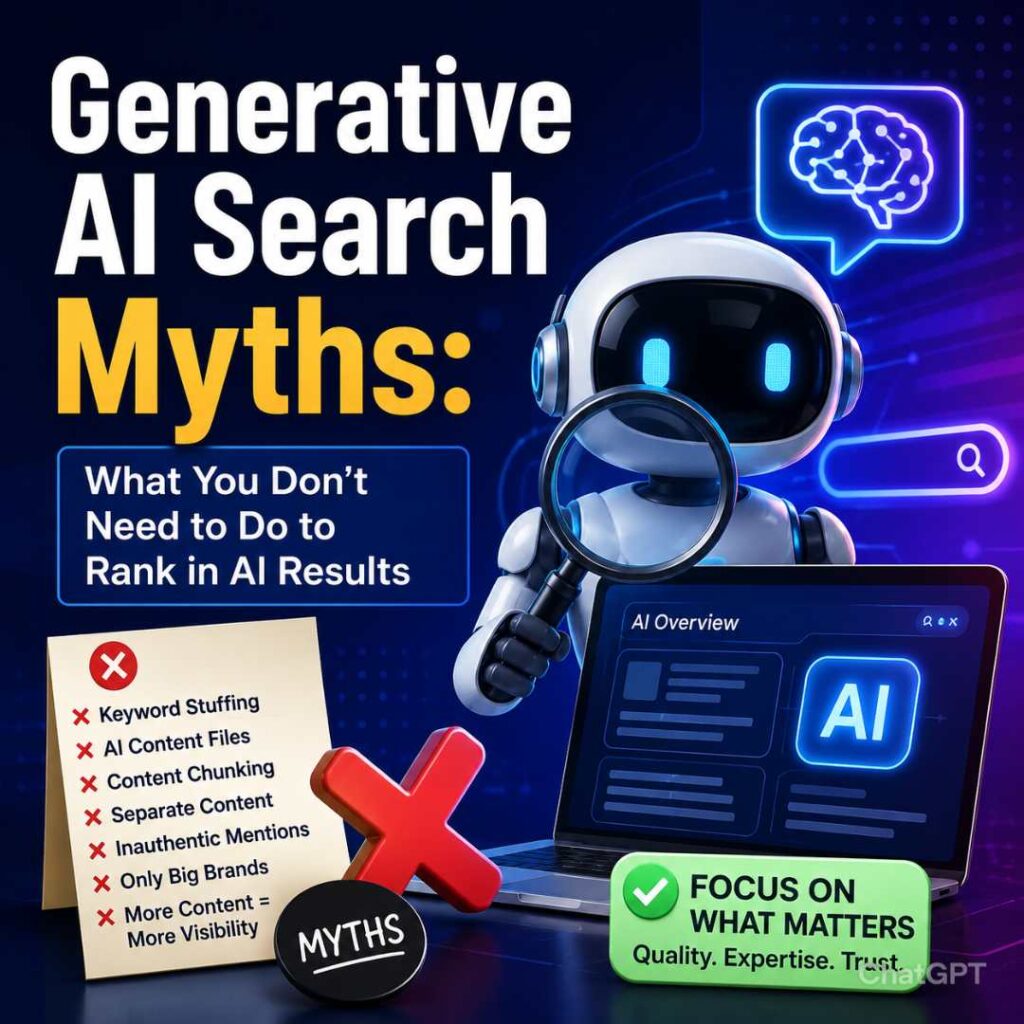
Generative AI Search Myths #4: Only Large Brands Can Appear in AI Search Results
Many small businesses assume AI search favors major publishers exclusively.
The evidence suggests otherwise.
Google’s systems prioritize usefulness, relevance, and trustworthiness over brand size alone.
Smaller websites frequently appear in AI Overviews when they provide:
- Unique expertise
- First-hand experience
- Detailed explanations
- High-value content
Why Expertise Matters More Than Size
A niche website with deep expertise can outperform a large brand covering a topic superficially.
This aligns closely with Google’s EEAT framework:
- Experience
- Expertise
- Authoritativeness
- Trustworthiness
Opportunity for Smaller Websites
Generative AI search may actually create more opportunities for niche experts to gain visibility.
Generative AI Search Myths #5: Publishing More Content Automatically Increases AI Visibility
Volume does not equal value.
Some marketers publish hundreds of low-quality articles hoping to increase AI visibility.
This strategy rarely produces sustainable results.
Google’s guidance consistently emphasizes quality over quantity.
Why More Content Isn’t Always Better
Publishing excessive content can create:
- Cannibalization
- Thin pages
- Index bloat
- Lower quality standards
What Works Better
Create:
- Original research
- Expert commentary
- Unique case studies
- Comprehensive guides
One exceptional article can outperform dozens of average posts.
Generative AI Search Myths #6: AI Search Only Uses Recently Published Content
Many marketers believe AI search systems only surface fresh content.
While freshness matters for certain topics, it’s not a universal ranking factor.
Evergreen content continues to perform well when it remains accurate and valuable.
AI Systems Consider Multiple Factors
Including:
- Relevance
- Accuracy
- Expertise
- Authority
- User intent
A three-year-old article can still be cited if it provides the best answer.
Best Practice
Regularly update important content rather than constantly creating new pages.
Google’s Official Myth Busting: What You Can Stop Worrying About
Google recently addressed several misconceptions surrounding AI search.
Here are some practices Google says you don’t need to focus on:
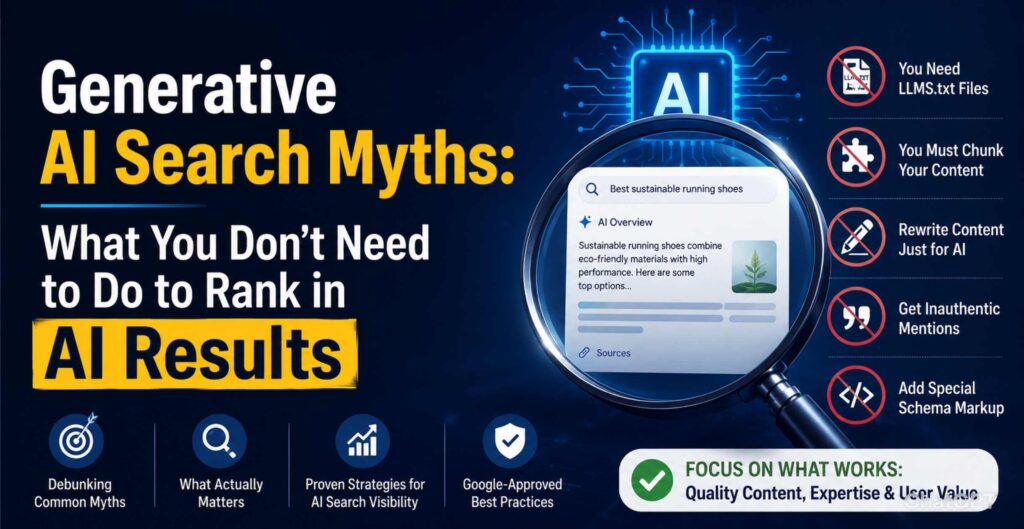
You Don’t Need LLMS.txt Files
Some SEO communities suggest creating special AI files such as:
- LLMS.txt
- AI-specific markdown files
- Custom machine-readable documents
Google has stated these are not required for visibility in generative AI search.
You Don’t Need Artificial Content Chunking
Another common myth involves splitting content into tiny sections solely for AI consumption.
Google’s systems can understand complete pages and extract relevant information without forcing content into micro-sections.
You Don’t Need to Rewrite Everything for AI
Modern AI understands:
- Synonyms
- Context
- Semantic relationships
You don’t need endless keyword variations or awkward AI-focused writing styles.
You Should Avoid Inauthentic Mentions
Buying mentions or forcing artificial brand references across the internet isn’t a sustainable strategy.
Google continues prioritizing quality signals and spam prevention.
Structured Data Helps – but Isn’t Required
Structured data remains valuable for SEO.
However, Google confirms there is no special schema required specifically for generative AI search.
What Actually Matters for Generative AI Search Optimization
Instead of chasing shortcuts, focus on proven optimization principles.
Create People-First Content
Ask:
- Does this solve a problem?
- Is it genuinely useful?
- Does it provide unique value?
Demonstrate Real Expertise
Include:
- Expert insights
- Case studies
- Original observations
- Industry experience
Build Strong Topical Authority
Cover topics comprehensively rather than publishing disconnected content.
Improve Technical SEO
Ensure:
- Fast page speed
- Mobile responsiveness
- Crawlability
- Indexability
Strengthen Trust Signals
Add:
- Author bios
- Citations
- References
- Contact information
These signals help establish credibility for both users and AI systems.
GEO and AEO Best Practices That Work
As Answer Engine Optimization and Generative Engine Optimization continue evolving, several best practices consistently deliver results.
Structure Content for Direct Answers
Use:
- Question-based headings
- Concise definitions
- Bullet lists
- Tables
Optimize for Voice Search
Write naturally and conversationally.
Voice searches often mirror real-world questions.
Use Entity-Based SEO
Connect topics, brands, products, and concepts clearly.
Entities help AI understand context more effectively.
Cover Topics Completely
AI systems prefer content that provides comprehensive answers.
Build Brand Authority
Earn:
- Reviews
- Citations
- Mentions
- Backlinks
Authority remains a powerful signal.
FAQs – Generative AI Search Myths
What are the biggest generative AI search myths?
The biggest Generative AI Search Myths include believing you need LLMS.txt files, separate AI content, keyword stuffing, content chunking, or massive publishing volume to rank in AI-generated search results.
Does SEO still matter for generative AI search?
Yes. SEO remains fundamental because AI systems rely on crawlable, indexable, trustworthy content. Strong technical SEO and quality content continue to influence visibility.
How does generative AI search rank content?
AI search evaluates relevance, expertise, authority, trustworthiness, content quality, and user intent. These AI search ranking factors help determine which sources contribute to AI-generated responses.
Do I need separate content for AI search engines?
No. Google has stated that websites do not need separate content specifically for AI search systems. Focus on creating valuable content for users.
What factors influence AI-generated search results?
Important factors include:
- Content quality
- EEAT signals
- Technical SEO
- User experience
- Topical authority
- Entity relationships
- Search intent alignment
Generative AI Search Myths
The rise of AI-powered search has generated excitement, innovation, and unfortunately, misinformation.
The truth is that most so-called AI search hacks are unnecessary.
Google’s guidance makes one thing clear: the fundamentals still matter.
Rather than chasing shortcuts such as LLMS.txt files, content chunking, or AI-specific rewrites, invest in creating helpful, trustworthy, expert-led content that genuinely serves your audience.
The websites most likely to succeed in generative AI search will be those that combine strong SEO foundations, EEAT principles, Answer Engine Optimization, and user-first content strategies.
As AI search continues evolving, the winning formula remains surprisingly simple:
Create exceptional content for people, and you’ll naturally improve your visibility in AI-powered search experiences.