
Back Button Hijacking Spam Policy: What It Means for SEO & Website Owners
The back button hijacking spam policy is one of the most important updates under the Google spam policy update 2026, and it directly targets websites that manipulate user navigation.
If your website interferes with how users go back to previous pages, Google may now treat it as a malicious practice leading to ranking drops or even manual penalties.
In simple terms:
Google is cracking down on websites that break user expectations.
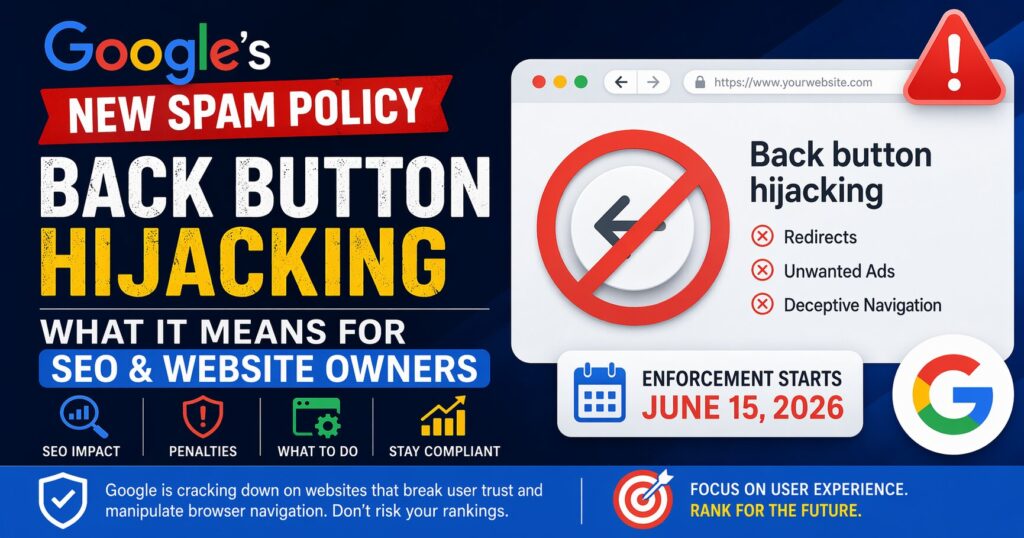
What Is Back Button Hijacking? (Google’s Official Definition)
Back button hijacking spam policy happens when a website interferes with the browser’s back button behavior.
According to Google:
When a user clicks the back button, they expect to return to the previous page. But in hijacking cases:
- Users are redirected to pages they never visited
- They see unwanted ads or recommendations
- They are prevented from leaving the page
This creates a mismatch between user expectations and actual experience, which violates Google search quality guidelines.
Why Google Introduced This Policy (Google Spam Policy Update 2026)
Under the Google spam policy update 2026, Google has officially classified back button hijacking as a malicious practice.
Why this matters:
- It breaks normal browser functionality
- It manipulates user behavior
- It creates frustration and distrust
Google clearly states:
Websites inserting deceptive pages into browser history are violating policies.
This aligns with the broader goal of improving user experience ranking factors.
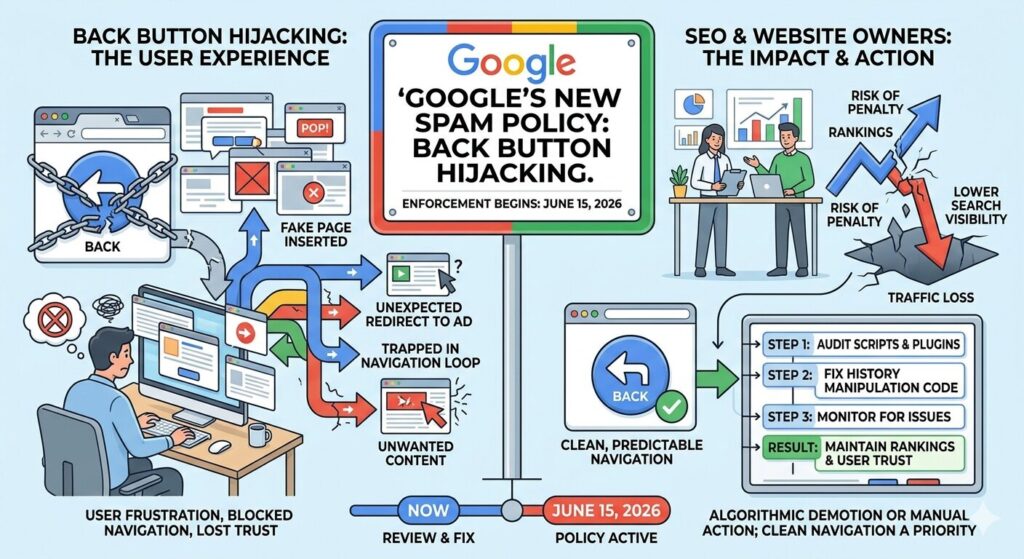
Enforcement Timeline You Must Know
Google has given website owners time to act.
Key date:
- June 15, 2026 → Enforcement begins
Until then:
- Audit your website
- Remove harmful scripts
- Fix UX issues
After this date, website spam penalties Google enforces will apply strictly.
Back Button Hijacking SEO Impact
The back button hijacking spam policy SEO impact is serious and immediate.
What can happen:
- Manual spam actions
- Automated ranking demotions
- Loss of organic traffic
- Reduced visibility in SERP & Discover
Google explicitly states that:
Sites engaging in this behavior may face manual or algorithmic penalties.
Why This Impacts Rankings More Than Ever
Google is now heavily focused on:
- User trust
- Navigation clarity
- Experience consistency
This means:
UX manipulation = SEO loss
Website Spam Penalties Google May Apply
If your site violates the back button hijacking spam policy, penalties include:
Possible actions:
- Manual action in Search Console
- Ranking suppression
- Partial or full deindexing
These website spam penalties Google applies are aligned with its malicious practices policy.
What Site Owners Should Do
Google has clearly outlined what you need to do.
1. Stop Interfering with Browser Navigation
Ensure users can:
- Click back
- Return to previous page instantly
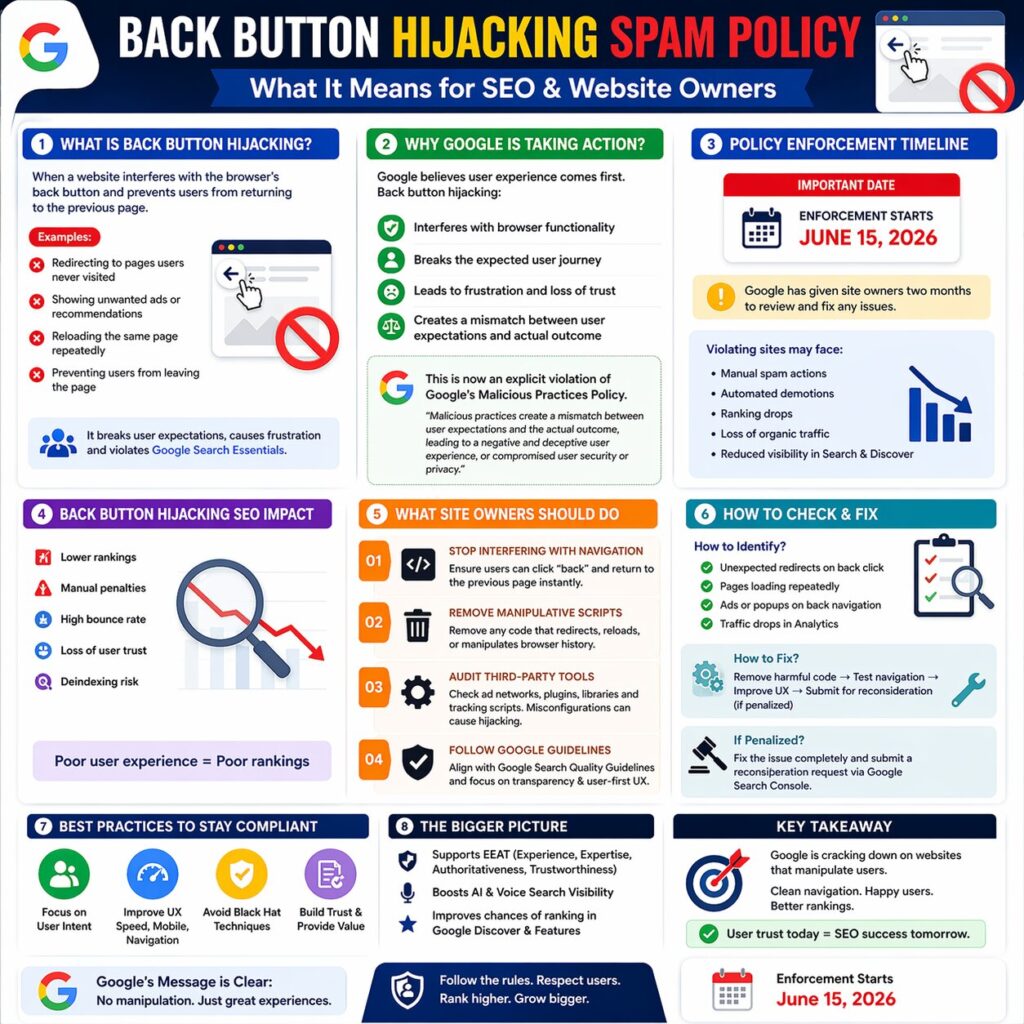
2. Remove Manipulative Scripts
Check for:
- JavaScript redirects
- History manipulation scripts
- Forced navigation loops
3. Audit Third-Party Tools
Important insight from Google:
Back button hijacking may come from:
- Ad networks
- External libraries
- Tracking scripts
So:
- Review all integrations
- Disable harmful configurations
4. Align with Google Search Quality Guidelines
Focus on:
- Transparency
- User-first design
- Clean navigation
How to Identify Back Button Hijacking on Your Site
Check for:
- Unexpected redirects when clicking back
- Pages loading repeatedly
- Ads appearing on back click
Tools:
- Google Search Console
- Browser testing
- Session recording tools
Recovery Process (If Penalized)
If your site is affected:
Step-by-step:
- Fix the issue completely
- Remove all manipulative code
- Test user navigation
- Submit reconsideration request
Google allows reconsideration via Search Console.
How This Update Impacts Modern SEO (AEO, GEO, Voice Search)
This update is not just about spam it’s about the future of SEO.
AEO (Answer Engine Optimization)
- Clean UX improves answer visibility
GEO (Generative Engine Optimization)
- AI prefers trustworthy, non-manipulative sites
Voice Search Optimization
- Requires seamless navigation
If your UX is broken, you lose across all channels.
Back Button Hijacking Directly Harms:
- Trustworthiness → Users feel manipulated
- Experience → Navigation becomes frustrating
- Authority → Google reduces credibility
This violates EEAT principles and impacts rankings.
Best Practices to Stay Safe in 2026
To comply with the Google spam policy update 2026:
✔️ Do:
- Keep navigation natural
- Prioritize user control
- Optimize UX
❌ Don’t:
- Manipulate browser history
- Force redirects
- Trap users in funnels
FAQs – Back Button Hijacking Spam Policy
What is the back button hijacking spam policy?
The back button hijacking spam policy is part of the Google spam policy update 2026, targeting sites that interfere with browser navigation and user expectations.
What is the back button hijacking SEO impact?
The back button hijacking SEO impact includes ranking drops, manual penalties, and reduced visibility due to poor user experience ranking factors.
Will Google penalize my website?
Yes. Google may apply website spam penalties Google defines, including manual actions and ranking demotions.
Why is Google cracking down on websites?
Because Google is cracking down on websites that create deceptive user experiences and violate Google search quality guidelines.
How can I fix back button hijacking?
Remove scripts, audit third-party tools, and ensure users can navigate freely without interference.
UX Manipulation Is Over
The back button hijacking spam policy makes one thing clear:
Google prioritizes users over tricks
With enforcement starting June 15, 2026, you still have time but not much.
If you want to stay safe:
- Fix navigation issues
- Audit your tech stack
- Focus on real user experience
Because in 2026 SEO:
User trust = Rankings