
Introduction – Google Removed FAQ Rich Results
Google Removed FAQ Rich Results from most search results, and the SEO industry immediately started asking questions. Many websites that depended on FAQ schema to improve visibility suddenly noticed fewer rich snippets, reduced SERP real estate, and lower click-through rates.
If you have been wondering why Google remove FAQ rich results, you are not alone.
For years, FAQ structured data was one of the easiest SEO wins. Adding FAQ schema could expand your search listing, increase visibility on mobile devices, and improve user engagement. But Google’s recent structured data changes completely changed how FAQ rich results work.
Now, only a limited set of authoritative government and health websites are consistently eligible for FAQ rich results. This update has forced marketers, publishers, bloggers, and SEO agencies to rethink their content strategy.
In this guide, we will explain: – Google Removed FAQ Rich Results
- Why Google removed FAQ rich results
- The real SEO impact of the update
- Whether FAQ schema still works
- What SEOs should do next
- How to optimize for AI search, voice search, and Google Discover in 2026
This article is designed according to Google’s EEAT guidelines, Answer Engine Optimization (AEO), Generative Engine Optimization (GEO), and modern SEO best practices.
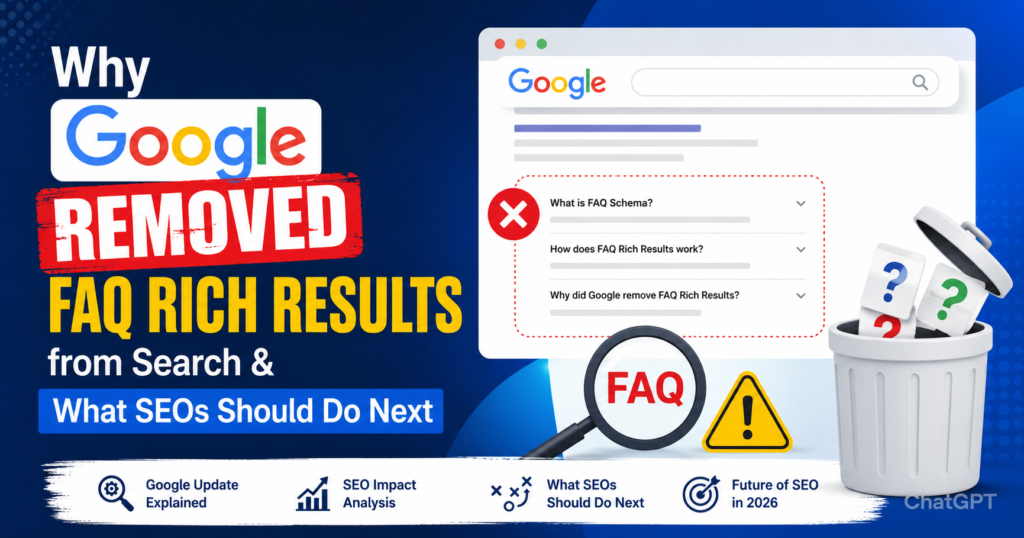
What Were FAQ Rich Results?
FAQ rich results were enhanced search listings that displayed questions and answers directly inside Google Search results.
These results appeared when websites implemented FAQ schema markup using structured data.
Example:
- What is SEO?
- How does SEO work?
- Why is SEO important?
Google would display these answers below the search snippet, increasing visibility and occupying more space in SERPs.
FAQ rich snippets became popular because they:
- Improved CTR (Click Through Rate)
- Increased search visibility
- Helped mobile SEO
- Enhanced voice search optimization
- Improved user experience
- Helped pages dominate SERP space
However, the system eventually became overused.
Why Google Removed FAQ Rich Results
Google Removed FAQ Rich Results Because of SERP Spam
The primary reason Google Removed FAQ Rich Results was misuse.
Many websites started adding unnecessary FAQ schema simply to gain more SERP space instead of genuinely helping users.
Google noticed:
- Repetitive questions
- Low-quality answers
- Keyword stuffing
- Duplicate FAQ content
- Misleading structured data
- Over-optimization
As a result, search results became cluttered.
Google wanted cleaner SERPs and better user experience.
Google Search Updates FAQ Visibility to Improve Quality
Another major reason behind the google search updates faq rollout was content quality control.
Google now prioritizes:
- Helpful content
- First-hand expertise
- Authoritative websites
- User satisfaction
- Reliable answers
Instead of showing FAQ rich snippets for every website, Google now selectively shows them for trusted government and health websites.
This change aligns with Google’s Helpful Content System and EEAT principles.
Google Structured Data Changes Were Focused on User Experience
The recent google structured data changes are all about improving search quality.
Google wants structured data to:
- Help search engines understand content
- Improve accessibility
- Support AI search systems
- Provide accurate information
Not manipulate SERP appearance.
That is why FAQ schema abuse became a target.
Google FAQ Schema Update Explained
What Changed in the Google FAQ Schema Update?
The google faq schema update significantly reduced FAQ rich result visibility across search results.
Before the update:
- Almost every website could display FAQ rich snippets
After the update:
- FAQ rich results are mostly limited to:
- Government websites
- Health-focused authoritative websites
Google officially stated that FAQ rich results are now shown less frequently.
This means:
- Schema markup may still exist
- But Google may not display the rich result
That distinction is important.
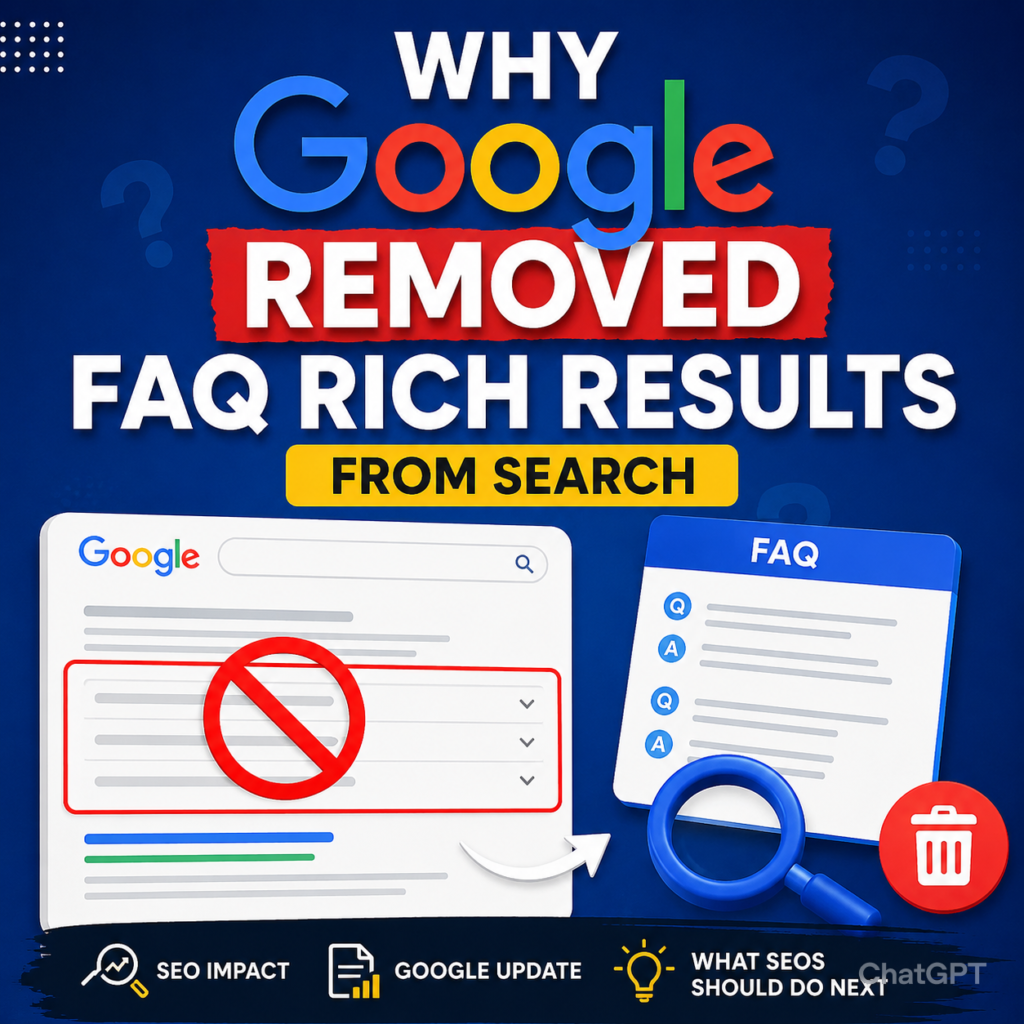
FAQ Rich Results Removed Does Not Mean Schema Is Dead
Many SEOs panicked after seeing faq rich results removed from their pages.
But structured data still has value.
Schema markup still helps:
- Search engines understand content
- AI systems interpret information
- Voice assistants process answers
- Search engines build topical context
Even when rich snippets are not visible.
FAQ Rich Results SEO Impact
Loss of SERP Real Estate
One of the biggest faq rich results seo impact issues is reduced visibility.
Previously:
- FAQ snippets expanded search listings
- Increased vertical space
- Improved CTR
Now:
- Listings appear smaller
- Competition becomes harder
- Organic visibility decreases
This especially affected publishers and affiliate websites.
Lower Click-Through Rates (CTR)
Many websites reported:
- Reduced CTR
- Lower engagement
- Traffic drops
Because FAQ rich snippets previously acted like mini-answer boxes inside SERPs.
Without them, users may skip listings.
More Importance on Content Quality
The removal shifted SEO focus toward:
- Better content
- Experience-based writing
- Topical authority
- EEAT optimization
- Original insights
This is actually positive for long-term SEO.
Does FAQ Schema Still Work in 2026?
Does FAQ Schema Still Work for SEO?
A common question is: does faq schema still work?
The answer is:
Yes – but differently.
FAQ schema still helps:
- Content understanding
- AI systems
- Semantic SEO
- Voice search
- Context building
But it no longer guarantees rich results.
FAQ Schema SEO 2026 Best Practices
For faq schema seo 2026, Google recommends using FAQ schema only when:
- Questions genuinely help users
- Answers are accurate
- Content is not promotional
- FAQs are visible on-page
- Information improves user experience
Avoid:
- Keyword stuffing
- Fake FAQs
- Duplicate questions
- Thin answers
What SEOs Should Do Next
Focus on EEAT Instead of SERP Tricks
Modern SEO is no longer about shortcuts.
Google now rewards:
- Experience
- Expertise
- Authoritativeness
- Trustworthiness
SEOs should:
- Add expert insights
- Use real examples
- Cite trustworthy sources
- Build topical authority
Build Content for AI Search Engines
AI search is growing rapidly.
Google’s AI Overviews, conversational search, and generative engines rely heavily on:
- Context
- Structured information
- Semantic clarity
To optimize:
- Use concise answers
- Add clear headings
- Use entity-based SEO
- Create question-focused sections
This improves Answer Engine Optimization (AEO).
Optimize for Voice Search
Voice search queries are conversational.
Example:
- “Why did Google remove FAQ rich results?”
- “Does FAQ schema still work?”
To optimize:
- Use natural language
- Write concise answers
- Add conversational FAQs
- Structure content clearly
Improve Google Discover Visibility
To improve Google Discover traffic:
Use Strong Headlines
Create curiosity-driven but accurate titles.
Add High-Quality Images
Use large featured images.
Publish Timely SEO Content
Google Discover rewards fresh topics.
Write Humanized Content
Avoid robotic AI-generated writing.
Focus on User Interest
Content must educate or engage.
Better Alternatives to FAQ Rich Results
Use How-To Schema
How-to content still performs well for:
- Tutorials
- Guides
- Processes
Example:
- How to recover traffic after FAQ schema removal
- How to optimize for AI search
Invest in Featured Snippets
Featured snippets remain powerful.
To optimize:
- Answer questions directly
- Use bullet points
- Add concise definitions
- Structure content properly
Build Topical Clusters
Instead of relying on one rich result:
- Build topic authority
- Create interconnected content
- Cover subjects deeply
Example cluster:
- Structured data SEO
- AI SEO
- Schema markup
- Rich snippets
- EEAT optimization
How to Optimize for AI Search & Generative Engines
Generative Engine Optimization (GEO) Matters Now
Traditional SEO is evolving.
Generative AI systems now summarize content directly.
To rank in AI-powered search:
- Write factual content
- Add original insights
- Use semantic entities
- Structure answers clearly
Use AI-Friendly Formatting
AI systems prefer:
- Short paragraphs
- Clear headings
- Bullet points
- Definitions
- Structured answers
This improves extraction into:
- AI Overviews
- Voice assistants
- Generative search tools
Add Contextual Relevance
Instead of keyword stuffing:
- Explain concepts deeply
- Connect related topics
- Add supporting examples
This strengthens semantic SEO.
Common SEO Mistakes After FAQ Removal
Continuing Old SEO Tactics
Some websites still:
- Add unnecessary FAQ schema
- Stuff keywords into FAQs
- Create fake questions
This no longer works.
Ignoring Search Intent
Modern SEO requires:
- Matching user intent
- Solving problems
- Delivering value
Not simply optimizing markup.
Overusing AI Content
Google values:
- Human experience
- Originality
- Expertise
Avoid publishing generic AI-written content without editing.
Future of Structured Data in Google Search
Structured data is not disappearing.
Instead, Google is becoming more selective.
Future schema strategies will focus on:
- Accuracy
- Trust
- Relevance
- AI understanding
Important schema types likely to remain valuable:
- Article schema
- Organization schema
- Breadcrumb schema
- Product schema
- Review schema
- Video schema
The future of SEO is semantic understanding, not SERP manipulation.
The reality is simple: Google Removed FAQ Rich Results because too many websites abused the system.
While this update reduced visibility for many websites, it also created an opportunity for better SEO practices.
The future belongs to websites that:
- Provide real value
- Demonstrate expertise
- Build trust
- Optimize for AI search
- Create user-focused content
Instead of chasing SERP tricks, SEOs should now focus on:
- EEAT
- Helpful content
- Voice search
- AI optimization
- Semantic SEO
- Google Discover strategies
FAQ schema still has value, but only when used properly.
SEO in 2026 is no longer about gaming algorithms.
It is about becoming the best answer.
FAQs – Google Removed FAQ Rich Results
Why did Google remove FAQ rich results?
Google removed FAQ rich results to reduce spam, improve search quality, and create cleaner SERPs. Many websites were misusing FAQ schema for ranking manipulation instead of helping users.
Does FAQ schema still work in 2026?
Yes, FAQ schema still works for content understanding, AI search, and semantic SEO. However, Google now shows FAQ rich results less frequently.
What is the SEO impact of FAQ rich results removed?
The major FAQ rich results SEO impact includes:
- Lower CTR
- Reduced SERP visibility
- Smaller search listings
- Greater focus on content quality
What should SEOs do after Google removed FAQ rich results?
SEOs should focus on:
- EEAT optimization
- Helpful content
- AI SEO
- Voice search
- Featured snippets
- Topical authority
Are Google structured data changes bad for SEO?
No. Google structured data changes encourage websites to prioritize quality and user experience over manipulative SEO tactics.
Read More Blogs – AI, SEO, Latest News